

Antiperspirant contains an aluminum-based active ingredient that reduces sweating in the treated area, plus ingredients that give the formula its texture, help it spread, and support the finished product. Depending on the formula, it can also contain odor-control ingredients, fragrance, moisturizers, preservatives, or moisture-absorbing powders. The active ingredient reduces perspiration; the other ingredients serve different purposes.
- What is in antiperspirant? Aluminum-based actives reduce sweat; supporting ingredients shape texture, application, scent, and stability.
- Duradry antiperspirants suit people seeking sweat reduction; deodorants and body washes perform different jobs.
- Read the Drug Facts panel for the active ingredient, intended use, application directions, and warnings.
- A higher active percentage does not automatically mean a better product for your skin or routine.
What is in antiperspirant?
An antiperspirant formula has two main parts: the sweat-reducing active and the supporting ingredients. On a U.S. antiperspirant label, the Drug Facts panel identifies the active ingredient and its concentration separately from the inactive ingredients.
Common antiperspirant actives include aluminum chloride, aluminum chlorohydrate, and aluminum zirconium compounds. These names describe different aluminum-containing substances, not interchangeable names for the same formula. For brand-specific context, the guide to aluminum in Duradry antiperspirants explains the distinction between sweat reduction and other product functions.
The rest of the formula matters, too. A product needs ingredients that hold its structure, distribute the active, and make application practical. Some formulas also combine sweat reduction with deodorant protection.
Read the active ingredient to understand sweat control, then read the rest of the formula to understand the product experience. Neither part tells the whole story alone.
Why this matters
If your underarms still feel wet after using deodorant, the issue is not necessarily how much you applied. Deodorant controls odor; antiperspirant reduces perspiration. A cleanser removes sweat and buildup during washing but does not prevent new sweat afterward.
That distinction helps you choose a product for a workday, workout, warm commute, or social plans without adding unnecessary steps. Start with the result you want: less wetness, odor protection, cleansing, or a combination.
An ingredient list also helps you make specific choices rather than relying on broad packaging language. If fragrance bothers your skin, check for fragrance. If you want sweat reduction, look for an antiperspirant active rather than assuming a powder or deodorizing ingredient performs the same job.
Aluminum-based actives reduce perspiration
Aluminum-based antiperspirant actives temporarily form plugs within sweat ducts near the skin's surface, reducing the amount of sweat that reaches the treated area. They do not remove sweat glands or permanently stop sweating.
You will encounter several active names when reading labels:
- Aluminum chloride: Used in some antiperspirant treatments, including formulas with specific nighttime application instructions.
- Aluminum chlorohydrate: An aluminum-based sweat-reducing active found in some antiperspirant formats.
- Aluminum zirconium compounds: Another group of antiperspirant actives, with longer names that identify the particular compound.
The full ingredient name matters. Do not shorten every aluminum compound to aluminum chloride or assume two products contain the same active because both say clinical strength.
Likewise, concentration is not a stand-alone ranking. Different actives, formulas, application areas, and directions make a percentage-only comparison incomplete. A product that fits your skin and schedule is more useful than a higher number you cannot comfortably use as directed.
Does antiperspirant aluminum mean the product is unsafe?
An aluminum ingredient is not, by itself, a reason to conclude that an antiperspirant is unsafe. The American Academy of Dermatology's hyperhidrosis treatment guidance states that research has not established the feared links between antiperspirant aluminum and breast cancer or Alzheimer's disease.
That does not replace product-specific warnings. Follow the label, avoid broken skin, and stop use if rash or irritation occurs. Antiperspirant labels also direct people with kidney disease to ask a doctor before use.
What do the other ingredients do?
Inactive does not mean unnecessary. It means an ingredient is not listed as the antiperspirant drug active; supporting ingredients still affect how the product applies, feels, and holds together.
Not every formula contains every group below. A solid stick and a water-based gel need different structures, and a fragrance-free product has different scent considerations from a scented one.
Carriers distribute the formula
Water and other carrier ingredients help deliver the formula across the application area. Their presence depends on the format and how the active is formulated.
The practical question is whether you can apply the product evenly according to its directions. Do not assume every liquid ingredient is a moisturizer or that every quick-drying product uses the same solvent system.
Structuring ingredients create the texture
Waxes, fatty alcohols, and gelling ingredients help create a solid stick or gel consistency. They keep the formula in a usable form rather than supplying the sweat-reducing action themselves.
Stearyl alcohol, for example, is a fatty alcohol. It is not the same substance as ethanol, so the word alcohol in an ingredient name does not tell you enough to judge the formula's feel or function.
Skin-conditioning ingredients affect application and feel
Emollients help a product spread and influence its skin feel. Humectants such as glycerin attract water and can be part of the supporting formula.
These ingredients do not guarantee that a finished product will be non-irritating. Your response depends on the complete formula, your skin, and how you use it—not one reassuring ingredient near the top of a product description.
Odor-control ingredients and fragrance have separate jobs
A combined antiperspirant and deodorant can include ingredients that help manage odor alongside its sweat-reducing active. Fragrance supplies scent; it is not evidence that the product reduces perspiration.
Scent notes describe a fragrance's character, not necessarily literal ingredients. A pear or cedar scent description does not establish that the formula contains pear extract or cedar essential oil.
Powders and preservatives support different functions
Powders can absorb moisture or change the feel of a formula. Absorbing moisture already present on skin is different from reducing perspiration through an antiperspirant active.
Preservatives help protect susceptible formulas from microbial growth. Not every product needs the same preservation system, and a missing familiar preservative name does not establish that a formula is preservative-free.
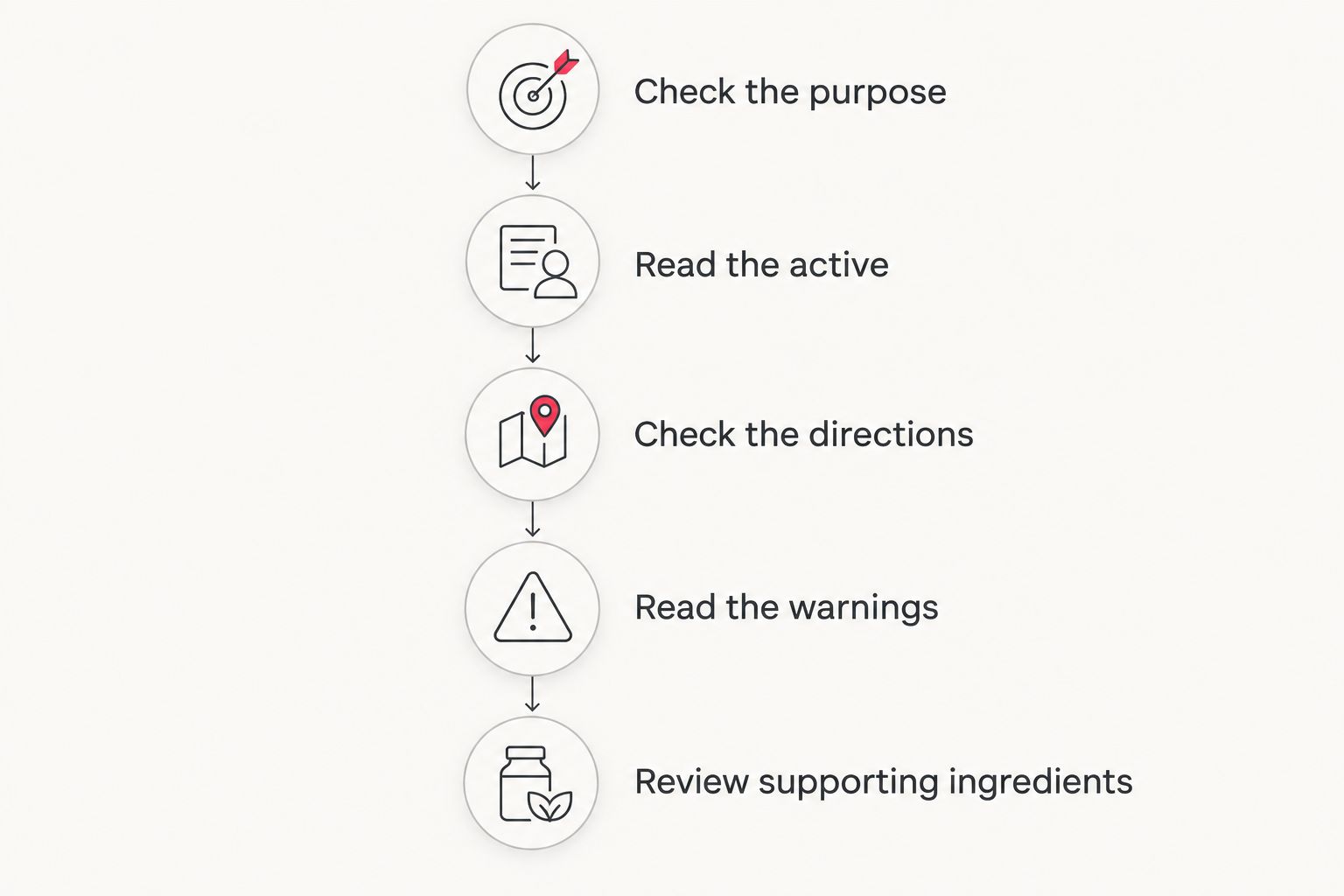
How do you read an antiperspirant label?
Read the package in this order before comparing marketing claims. The current label is the instruction source for the product you actually have, including its intended application area.
- Check the purpose. Confirm that the product is an antiperspirant, a deodorant, or both. Similar packaging does not establish the same function.
- Read the active. Find the full active ingredient name and concentration in the Drug Facts panel. Keep those details attached to that specific product.
- Check the directions. Identify where, when, and how much to apply. Underarm instructions do not automatically extend to hands, feet, or other body areas.
- Read the warnings. Look for restrictions involving irritated skin, shaving, bathing, or health conditions. Do not treat application advice from another product as a substitute.
- Review supporting ingredients. Check fragrance and ingredients you specifically need to avoid. Use the package list rather than assuming an older online list matches your product.
Package directions also prevent a common mistake: assuming more product means better protection. Applying extra layers or combining multiple antiperspirants is not a substitute for using the correct amount on the correct area.
Why antiperspirant ingredients vary
Ingredient differences often reflect the product's job and format rather than a simple good-versus-bad distinction. Compare these factors before deciding that a longer ingredient list or unfamiliar name makes a product unsuitable:
- Format: A stick needs a structure that holds its shape; a gel needs a suitable gel system. A wipe also needs a liquid formula compatible with its delivery format.
- Sweat versus odor protection: A combined antiperspirant and deodorant has a different brief from an odor-only product.
- Application area: Underarm and body products have their own directions. Permission to use one format on a particular area does not transfer to another.
- Application schedule: Daily protection and a bedtime routine involve different instructions and practical commitments.
- Fragrance preference: Scented and fragrance-free formulas serve different preferences. Neither description guarantees universal skin tolerance.
Choose by function, permitted body area, and instructions before comparing ingredient claims. This keeps the decision focused on what you need the product to do.
What does “clean” mean on an antiperspirant?
Clean is not a substitute for an ingredient list. A useful explanation identifies the actual formulation choices—such as a verified absence of talc, silicones, or dyes—without suggesting those exclusions prove universal safety.
Naturally derived also does not mean aluminum-free, organic, synthetic-free, or unable to cause irritation. A naturally derived percentage is not a sweat-reduction score.
Mineral language needs the same care. Potassium alum contains aluminum, but its presence alone does not establish that a product is a proven antiperspirant. Check the product's stated purpose and labeling rather than drawing that conclusion from one ingredient.
For modern sweat care, the useful balance is effective sweat reduction plus ingredient choices you understand. You do not have to treat those priorities as opposites.
Where does a daily antiperspirant stick fit?
Duradry Clinical Sweat Control Stick is best for people seeking daily underarm sweat and odor protection in a familiar stick format. It combines an antiperspirant role with deodorant protection rather than asking an odor-only product to handle wetness.
The Clinical Sweat Control Stick is positioned for daily use on clean, dry underarms, with directions describing 2–4 swipes per underarm. Its product materials identify talc-free, silicone-free, and dye-free formulation choices.
Its limits matter alongside its benefits. The stick is for underarms, not unrestricted body application; its fragrance options are not fragrance-free. It also does not guarantee zero irritation, zero transfer, or permanent dryness.
Duradry's sweat care approach separates everyday protection, more focused sweat control, cleansing, and odor care. You do not need every category simply because each has a place in the assortment.
FAQ
What ingredient in antiperspirant actually stops sweat?
An aluminum-based antiperspirant active reduces perspiration in the treated area. It temporarily limits sweat reaching the skin's surface rather than removing sweat glands or permanently stopping sweating.
Is antiperspirant the same thing as deodorant?
Antiperspirant reduces perspiration, while deodorant controls odor. A combined product can do both, but an odor-only deodorant does not establish sweat reduction.
Does a higher aluminum percentage mean better protection?
A higher aluminum-active percentage does not automatically mean better protection for you. The active compound, complete formula, application directions, and your skin's response all matter.
Why does antiperspirant have alcohol in the ingredients?
Different alcohol ingredients serve different formulation purposes. Fatty alcohols such as stearyl alcohol are chemically different from ethanol, so check the full ingredient name rather than judging by the word alcohol alone.
Can a natural deodorant work like an antiperspirant?
A natural deodorant does not become an antiperspirant because it contains powders, minerals, or botanical ingredients. Check for an antiperspirant active and the product's labeled purpose if reducing wetness is your goal.
What should I do if antiperspirant irritates my skin?
Stop use if rash or irritation occurs, as antiperspirant labels direct. Do not increase the amount or continue through worsening symptoms; persistent or severe reactions warrant professional advice.
One last thing
The longest ingredient name is not necessarily the ingredient you need to avoid, and the shortest list is not automatically the best fit. An ingredient name identifies a substance; the complete formula and its directions determine the practical choice.
Before your next purchase, check three things on the package: the product's purpose, its active ingredient, and its permitted application area. That gives you a more useful starting point than a broad clean, natural, or clinical claim alone.

