

Yes—genetics can contribute to excessive sweating, particularly primary focal hyperhidrosis, which often runs in families and affects specific areas such as the underarms, palms, feet, or face. A family history supports that possibility but does not prove the cause; new, widespread, or sleep-related sweating needs a separate medical assessment.
- Can genetics cause excessive sweating? Yes—primary focal hyperhidrosis can run in families, but family history alone cannot diagnose it.
- Sweating location, age at onset, timing, and medication history help distinguish possible causes.
- Antiperspirants reduce wetness; deodorants address odor. Neither changes inherited traits.
- Duradry sweat care offers topical underarm protection, not treatment for an underlying medical cause.
Why this matters
Inherited sweating is manageable, but assuming every episode is genetic can delay the right care. A pattern you have had since adolescence deserves a different conversation from sweating that began suddenly last month.
You also do not need a diagnosis to address ordinary underarm wetness. If you are unsure where everyday sweating ends and a medical concern begins, start with whether sweating a lot is a sign of hyperhidrosis.
Can genetics cause excessive sweating?
Yes. The American Academy of Dermatology and the International Hyperhidrosis Society identify family history as a feature of primary hyperhidrosis. This is excessive sweating that is not explained by another medical condition or a medication.
The word focal means the sweating affects particular areas rather than the entire body. Common sites include the underarms, hands, feet, and face. Sweating often affects matching areas on both sides, such as both palms, and typically occurs while you are awake.
Genetics describes an inherited tendency—not a guarantee that you will develop the same symptoms as a relative. Family history is one part of the evidence a clinician considers alongside the location, timing, duration, and effect on daily life.
Clinical assessment commonly considers these features:
- Duration: Focal excessive sweating has lasted at least 6 months without an apparent cause.
- Frequency: Episodes occur at least once per week.
- Age at onset: Symptoms began before age 25 years.
- Pattern: Sweating affects both sides in a relatively symmetrical way.
- Daily impact: Wetness interferes with activities, clothing, work, or handling objects.
- Sleep: The focal sweating stops during sleep.
- Family history: A relative has a similar sweating pattern.
These are recognized clinical features, not a self-diagnosis checklist. You do not need every feature, and no single feature proves that your sweating is inherited. A clinician must also consider other explanations.
What inherited sweating usually looks like
Primary focal hyperhidrosis commonly starts in childhood or adolescence. You might remember damp school papers, difficulty gripping a pen, or underarm wetness that continued even when you were sitting in a comfortable room.
That history matters because excessive sweating is not defined only by how much sweat you see. Context matters too. A soaked shirt after a hard workout is different from repeatedly sweating through clothing at rest.
A useful family conversation goes beyond asking whether anyone “sweats a lot.” Ask where the sweating happens, when it began, and whether it affects everyday activities. Similar patterns are more informative than a general dislike of hot weather.
Avoid comparing severity as though a relative's experience sets the threshold for yours. Your parent might manage damp palms without much disruption while your work involves handling paper, wearing gloves, or using touchscreens. The effect on your own day belongs in the medical conversation.
Does having a sweaty parent mean I will have hyperhidrosis?
- A parent with primary hyperhidrosis makes family history relevant, but it does not establish whether you will develop the condition or how severe it will be. There is no dependable personal inheritance percentage you can calculate from one relative's experience.
Likewise, relatives do not have to sweat in exactly the same places for their histories to be useful. Describe the differences rather than trying to make your symptoms fit a family pattern.
Can I have primary hyperhidrosis without a family history?
Yes. A known family history is not required for primary hyperhidrosis. Some relatives have never discussed their symptoms, and some people have no recognized affected relatives.
The absence of a family history does not rule out excessive sweating that deserves care. Your own symptoms remain the starting point.
Why excessive sweating varies
An inherited tendency does not explain every change in wetness. Several factors affect how sweating appears or how disruptive it feels:
- Body area: Damp palms affect grip and paperwork; underarm sweating affects clothing. The appropriate treatment also depends on the site.
- Heat and activity: Warm weather, exercise, and a crowded commute create an ordinary need to cool down. These situations do not establish hyperhidrosis by themselves.
- Emotional triggers: Stress and anticipation can trigger sweating. That does not mean the sweating is imaginary or simply a matter of staying calm.
- Medication use: Some medicines cause increased sweating. A clinician or pharmacist can review the timing without you stopping prescribed treatment yourself.
- Medical or hormonal changes: Thyroid problems, low blood sugar, and menopausal symptoms are among the possible explanations a clinician considers when appropriate.
- Product choice and application: Deodorant does not do the same job as antiperspirant. Applying an antiperspirant outside its directions also complicates judging the result.
Separate the underlying pattern from the immediate trigger. Stress before a presentation can worsen a longstanding sweating problem without being its only explanation.
When not to assume sweating is genetic
A family history should never explain away a new symptom automatically. Secondary hyperhidrosis means sweating associated with another condition or a medication, and its management depends on identifying that cause.
Arrange a medical assessment when sweating starts suddenly, becomes widespread, occurs during sleep, or changes substantially from your usual pattern. Mention associated symptoms such as fever, unexplained weight loss, a racing heartbeat, or feeling unwell.
Sweating with chest pain, significant shortness of breath, fainting, or other signs of an acute illness requires urgent medical attention. Do not wait for a sweat care product to work in that situation.
Nighttime sweating deserves a particularly clear distinction. Applying an antiperspirant at bedtime is a product-use schedule; it does not mean that product treats night sweats or the condition causing them.
You should also seek help when longstanding sweating repeatedly interrupts work, sleep, relationships, or ordinary tasks. You do not have to wait until a symptom becomes severe enough to disrupt every part of life.
How to prepare for a conversation about inherited sweating
A clear history is more useful than trying to measure every drop of sweat. Bring examples that show the pattern and its effect, rather than arriving with a diagnosis you feel you need to defend.
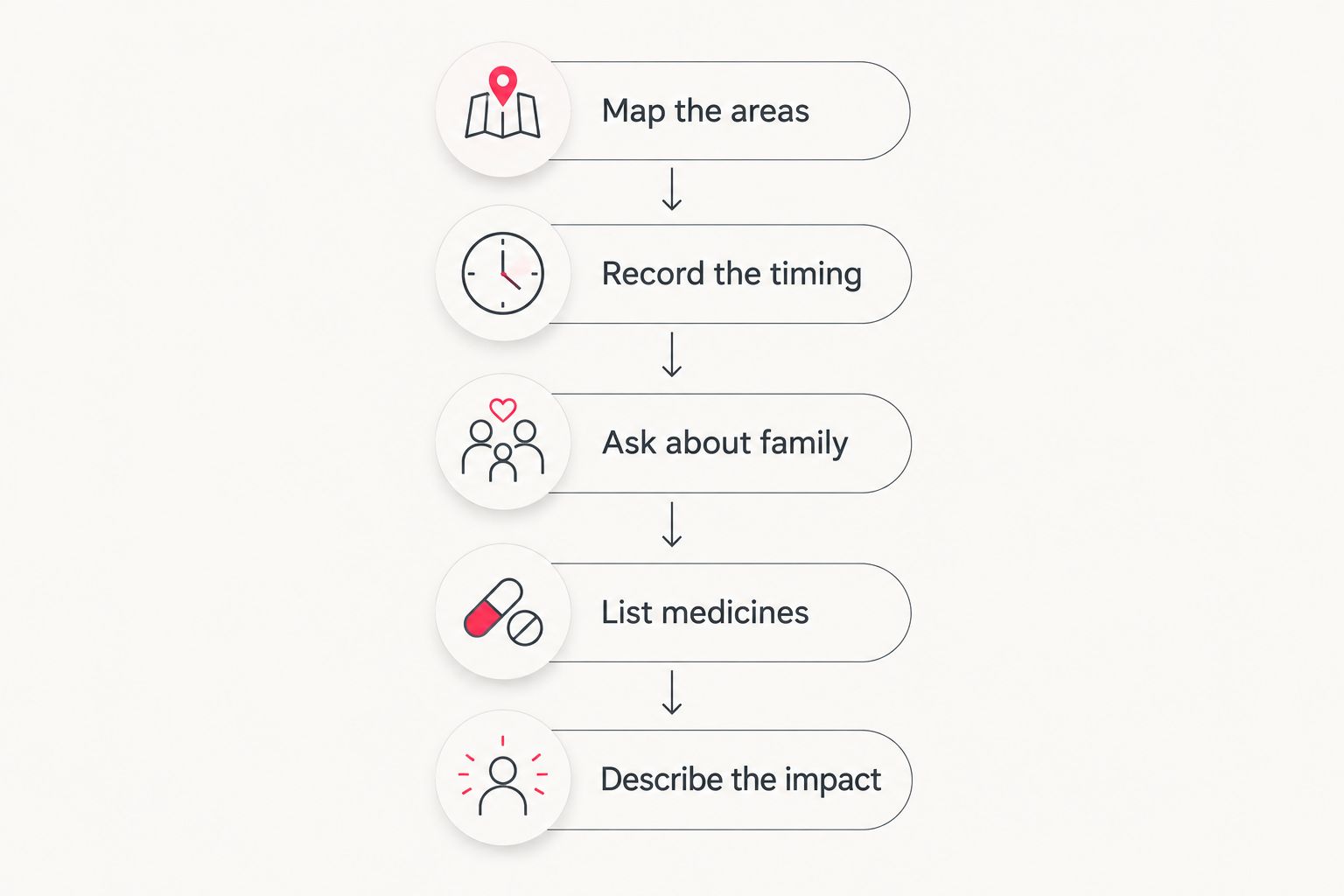
- Map the areas. Note whether sweating affects your underarms, palms, feet, face, or much of your body. Record whether both sides are involved.
- Record the timing. Describe when it began, whether it happens at rest, and whether you wake with wet clothing or bedding.
- Ask about family. Note relatives with similar symptoms, including their affected areas and approximate age at onset.
- List medicines. Include prescriptions, nonprescription products, and supplements, especially anything started or changed near symptom onset.
- Describe the impact. Give concrete examples: changing shirts at work, losing your grip, or avoiding certain clothing.
A clinician uses this information to decide whether the pattern fits primary focal hyperhidrosis or needs investigation for another cause. Testing is guided by the history and examination, not simply by having a relative who sweats heavily.
Bring your current product names too. Explaining that you tried an odor-only deodorant tells a clinician something different from describing consistent use of a labeled antiperspirant.
What helps if excessive sweating runs in your family?
Treatment targets sweating and its impact; it does not need to change your genes to help. Antiperspirants are a common starting point for localized wetness, while persistent symptoms deserve a discussion about additional options.
Depending on the body area and your medical history, a clinician can discuss prescription topical treatments, iontophoresis, botulinum toxin injections, or oral medication. These options have different practical demands and side effects; stronger treatment is not automatically the right first choice for everyone.
For everyday care, identify the job before choosing the format:
- Antiperspirant: Best for reducing wetness in the areas permitted by its label. Its limitation is that it does not treat an underlying systemic cause.
- Deodorant: Best for odor protection when wetness is not the main concern. Its limitation is that odor control alone does not establish sweat reduction.
- Body cleanser: Best for washing away sweat, odor, and buildup. Its limitation is that cleansing does not prevent new perspiration.
You do not need to add every category. If your main concern is wetness, switching between odor-only products leaves the central problem unaddressed.
Daily underarm wetness and odor
Duradry Clinical Sweat Control Stick is best for people seeking daily underarm sweat and odor protection. The Clinical Sweat Control Stick combines antiperspirant and deodorant functions in a familiar daily format.
The product directions specify clean, dry underarms and 2–4 swipes per underarm. Follow the current package, including its warnings, rather than increasing the amount because sweating seems hereditary.
The limitation is scope: this is underarm protection, not a treatment for every body area or an inherited condition itself. Irritation is possible, and persistent sweating despite correct use warrants reassessment rather than endless reapplication.
Heavier underarm sweating
The Intensive Sweat Minimizing Gel adds a focused bedtime antiperspirant step. It is best for people seeking more intensive underarm sweat control than a basic daily routine provides.
Duradry's directions describe a pea-sized amount per underarm on completely dry skin at bedtime, followed by thorough washing the next morning. Do not apply immediately after bathing or to broken, irritated, or recently shaved skin; follow the current label for the starting and maintenance schedule.
The tradeoff is an additional nighttime step and morning wash-off. The gel is for underarms only and is not designed to treat sweating during sleep. Stop use if rash or irritation occurs, and follow the label's advice to ask a doctor before use if you have kidney disease.
FAQ
Is excessive sweating always inherited?
No. Excessive sweating can be associated with primary hyperhidrosis, medications, medical conditions, or hormonal changes. Family history is useful context, not proof of the cause.
Can genetic sweating start when I am an adult?
Primary hyperhidrosis can be recognized in adulthood, but a new adult-onset sweating pattern should not automatically be labeled genetic. A clinician should review when symptoms actually began, medication changes, and other possible causes.
Can I get a genetic test to find out why I sweat so much?
Genetic testing is not routinely used to diagnose primary focal hyperhidrosis. Assessment usually centers on your symptoms, family history, medical history, and examination.
Will I pass excessive sweating on to my children?
A family history does not guarantee that your children will develop excessive sweating. It also cannot predict their affected body areas or symptom severity.
Does hereditary sweating mean I have poor hygiene?
No. An inherited tendency toward excessive sweating is not evidence of poor hygiene. Cleansing addresses sweat and buildup on the skin, while antiperspirants have the separate job of reducing wetness.
Can antiperspirant help if my sweating is genetic?
Yes. Antiperspirants can help reduce sweating in treated areas even when primary hyperhidrosis runs in the family. Use the correct product for the body area and seek medical advice if symptoms remain disruptive.
Can Duradry cure genetic excessive sweating?
No. Duradry sweat care products do not change inherited traits or cure hyperhidrosis. Its antiperspirants provide topical sweat control within their labeled uses, while other products serve odor-care or cleansing roles.
One last thing
Your response to antiperspirant cannot tell you whether sweating is genetic. Improvement shows that the routine helps manage wetness; it does not establish the original cause.
Before your next appointment, write down when sweating began, where it happens, and whether it occurs during sleep. That short history gives you a useful next step without turning ordinary sweat care into a guessing game.

