

Yes—prescription tablets for excessive sweating, including glycopyrrolate and oxybutynin, can reduce perspiration, but they do not permanently stop sweating or work for everyone. In the United States, clinicians prescribe these oral medicines off-label for hyperhidrosis, meaning sweating is not their FDA-approved indication. The main tradeoff is body-wide side effects, including dry mouth, constipation, blurred vision, and reduced ability to cool yourself in hot conditions.
- Tablets for excessive sweating include prescription glycopyrrolate and oxybutynin; both require medical supervision.
- Oral anticholinergics reduce sweating but can impair cooling during exercise and hot weather.
- Duradry sweat care suits people seeking targeted antiperspirant protection, not treatment for an underlying medical cause.
- Sudden sweating or new night sweats needs assessment rather than simply stronger sweat control.
Are there pills that stop excessive sweating?
Yes, but the goal is manageable sweating—not eliminating your body's cooling system. Oral anticholinergic medicines reduce the nerve signals that stimulate sweat glands. Because you swallow them, their effects are not confined to your underarms, hands, or feet.
Glycopyrrolate and oxybutynin are established prescription options used for hyperhidrosis. Neither is an over-the-counter supplement, and neither should be borrowed from someone else's prescription.
The practical distinction is where treatment acts:
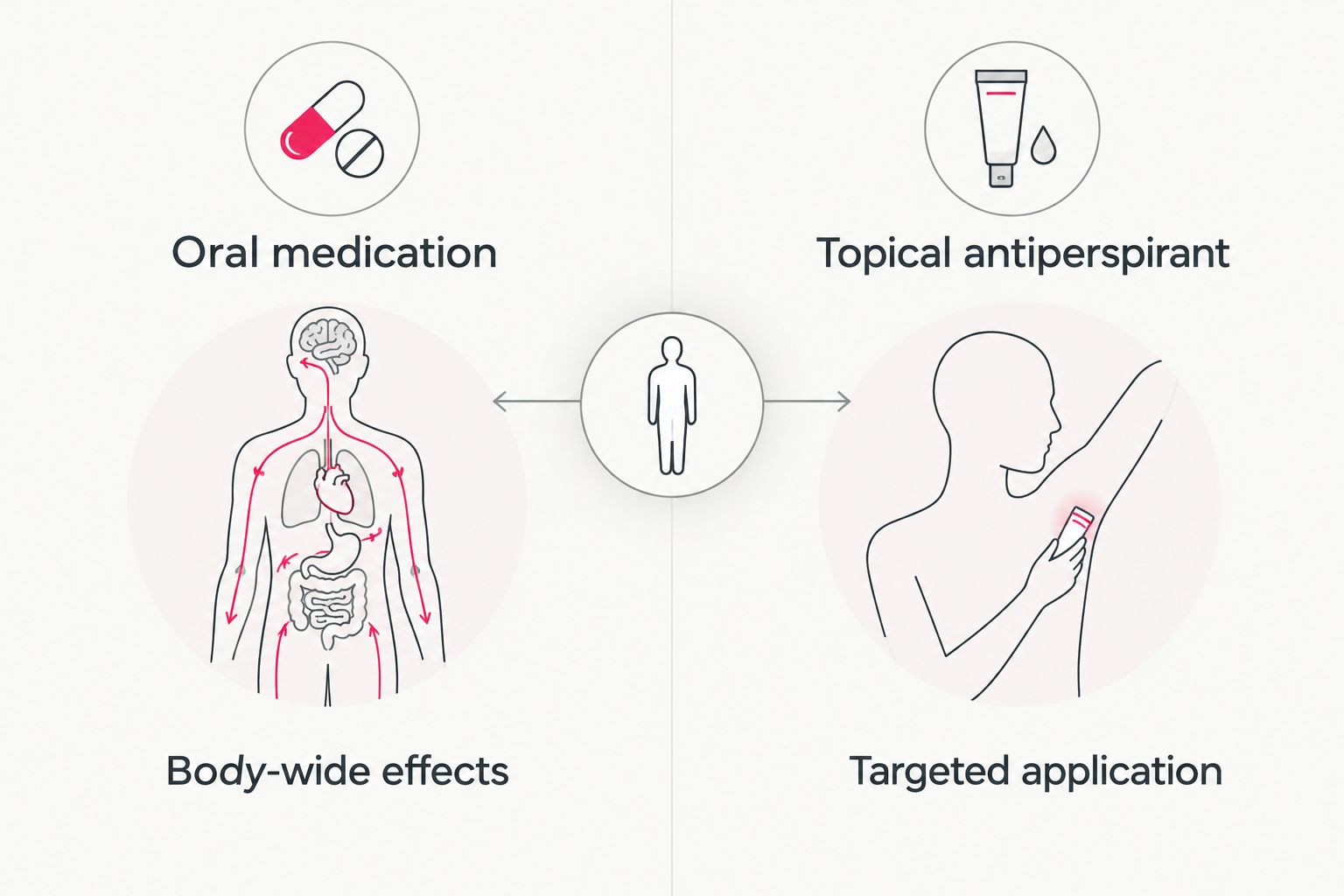
- Oral medication: Reduces sweating through effects throughout the body, with the possibility of body-wide side effects.
- Topical antiperspirant: Reduces sweating in the treated area, subject to that product's directions and skin tolerance.
For a concern limited to your underarms, start by understanding how to stop sweaty armpits. Widespread sweating calls for a different discussion than wetness in one area.
Why this matters: less sweat is not the only goal
A medicine that reduces wetness can also make heat harder to tolerate. That matters during a crowded commute, a workout, an outdoor shift, or travel somewhere warm.
The right treatment needs to fit your symptoms and your day. You should be able to function comfortably without trading wet clothes for troublesome dry mouth, difficulty urinating, or overheating.
Sweating also has different causes. Longstanding, localized excessive sweating is not the same clinical problem as sweating that begins after a medication change or suddenly appears during sleep. Identifying the pattern comes before choosing a pill.
Glycopyrrolate tablets: an off-label prescription option
Glycopyrrolate is an anticholinergic medicine that clinicians use off-label to manage excessive sweating. It blocks acetylcholine's action at certain receptors, reducing the signals that tell sweat glands to release sweat.
Best fit for discussion: Persistent or widespread sweating when a clinician considers oral treatment appropriate, including when localized treatment has not provided enough control.
Its practical advantage is that treatment is not restricted to a single application site. You do not need to apply a product separately to every affected area, although that convenience comes with systemic exposure.
The limitations are important. DailyMed prescribing information for glycopyrrolate tablets lists anticholinergic effects such as dry mouth, constipation, blurred vision, and urinary retention, along with warnings about heat-related illness from decreased sweating.
Glycopyrrolate enters the central nervous system less readily than some other anticholinergics. That does not make it free of side effects or automatically suitable for someone concerned about cognition.
Your prescriber determines the formulation, dose, and schedule. Do not increase the amount because a hot day or stressful meeting produces breakthrough sweating.
Oxybutynin tablets: another off-label option
Oxybutynin is an anticholinergic medicine approved for bladder-related conditions and also prescribed off-label for excessive sweating. Like glycopyrrolate, it reduces sweat signaling rather than treating every possible underlying cause of sweating.
Best fit for discussion: People whose sweating warrants systemic treatment after a clinician reviews their symptoms, other medicines, and health history.
Oxybutynin offers another oral treatment option when a clinician is assessing how to manage persistent symptoms. It is not automatically the better choice because someone else had a good response to it.
DailyMed prescribing information for oxybutynin chloride tablets includes dry mouth, constipation, blurred vision, and warnings about reduced sweating in high temperatures. Oxybutynin also has central nervous system warnings, including possible confusion and sleepiness.
These effects matter if you drive, work with equipment, or already take medicines that cause drowsiness or have anticholinergic effects. Older adults need particular attention to the overall anticholinergic burden.
Do not switch between oxybutynin and glycopyrrolate without your prescriber. Different medicines and formulations are not interchangeable dose for dose.
Why the choice of sweating tablet varies
There is no single best tablet for everyone with hyperhidrosis. The decision depends on more than how much you sweat.
- Affected areas: Widespread sweating can make systemic treatment relevant; localized sweating also has targeted treatment options.
- Underlying cause: A new illness, medication effect, or hormonal change needs assessment rather than symptom suppression alone.
- Heat exposure: Outdoor work, exercise, and warm environments change the consequences of reduced sweating.
- Medical history: Glaucoma, urinary retention, gastrointestinal conditions, and other health concerns can affect suitability.
- Other medicines: Anticholinergic effects can add up across prescriptions and some nonprescription medicines.
- Side-effect tolerance: A reduction in wetness is not a useful result if constipation, dry mouth, or blurred vision disrupts your day.
Bring your full medication list to the appointment, including allergy medicines, sleep aids, and supplements. Let the clinician assess interactions rather than assuming nonprescription products do not count.
Oral medication or topical antiperspirant?
Oral medication offers sweat reduction without treating each affected patch of skin separately. Its limitation is body-wide effects: the same medicine that reduces sweating can also affect your mouth, bowel, bladder, eyes, and temperature regulation.
Topical antiperspirant offers targeted application. Its limitation is that it works where you apply it, and some formulas cause local irritation. Body-area directions also differ, so an underarm product is not automatically appropriate for hands, feet, or the face.
A dermatologist can also discuss options such as iontophoresis for suitable areas or botulinum toxin injections. Those treatments have their own practical requirements and limitations; choosing a tablet is not the only next step after an antiperspirant disappoints.
If a topical routine has not worked, explain exactly what you tried. Product type, application timing, skin dryness, and irritation all help distinguish an unsuitable routine from a treatment that genuinely did not provide enough control.
Where targeted sweat care fits
At Duradry, we make topical sweat care, not prescription tablets. Our products serve specific roles, and none should be presented as treatment for an underlying cause of widespread sweating.
Duradry sweat care is best for people seeking targeted antiperspirant protection rather than oral medication. For everyday underarm wetness and odor, the Clinical Sweat Control Stick is the straightforward starting point. Its directions specify 2–4 swipes per underarm on clean, dry skin.
For heavier underarm sweating, the Intensive Sweat Minimizing Gel adds a nighttime antiperspirant step. Apply a pea-sized amount per underarm at bedtime, following the current label; wash it off thoroughly the next morning before drying the skin and applying daytime protection.
The gel's limitation is its underarm-only use and the need to respect its application restrictions. Do not apply immediately after bathing or to broken, irritated, or recently shaved skin. Stop use if rash or irritation occurs, and ask a doctor before use if you have kidney disease.
Although the gel is applied at bedtime, it is not designed to treat night sweats. Its nighttime schedule supports less underarm sweating during the day.
Do not add extra applications or combine multiple antiperspirants to compensate for an oral medicine that is not working as expected. Ask your prescriber how topical care fits your treatment plan.
What should you ask before starting sweating tablets?
Use the appointment to agree on a treatment goal and a safety plan—not simply to request a particular medicine.
- Describe the pattern. Explain which areas sweat, when it started, whether it occurs during sleep, and how it affects work, clothing, exercise, or social plans.
- List previous treatments. Include the product, application area, schedule, benefit, and any irritation.
- Explain your heat exposure. Mention outdoor work, training, travel, or a workplace without reliable cooling.
- Review your health and medicines. Ask specifically about urinary, eye, bowel, and cognitive concerns relevant to your history.
- Agree on follow-up. Ask which side effects require a call, which require urgent attention, and how the prescriber will assess benefit.
Do not use a dose suggested by a forum as a starting plan. The formulation and your health history matter, and dose adjustments belong with the clinician prescribing it.
Can sweating tablets make exercise unsafe?
Sweating tablets can increase the risk of overheating because they reduce your ability to release heat through sweat. Your prescriber needs to know if exercise, outdoor work, or hot environments are part of your routine.
Ask for specific guidance about activity and heat exposure. Drinking water does not remove the risk created by impaired cooling. Confusion, collapse, or suspected heatstroke requires emergency help.
Do sweating tablets cure hyperhidrosis?
Sweating tablets manage symptoms; they do not permanently cure hyperhidrosis. Their benefit depends on continued treatment and tolerability, under a clinician's supervision.
A useful treatment goal is less disruption to daily life. Complete dryness everywhere is neither a necessary goal nor a safe measure of success.
When should you get checked instead of changing products?
Arrange medical assessment for sudden, unexplained sweating, new night sweats, or sweating accompanied by symptoms such as fever or unexplained weight loss. A clinician can assess whether another condition or a medicine is contributing.
Sweating with chest pain, severe shortness of breath, or fainting needs urgent medical attention. Do not assume those symptoms are ordinary hyperhidrosis.
Persistent sweating that disrupts your life also deserves attention, even without warning signs. You do not need to wait until the problem becomes severe before asking about treatment options.
FAQ
Can I buy tablets for excessive sweating over the counter?
Glycopyrrolate and oxybutynin require a prescription in the United States. Do not substitute a supplement or borrow someone else's medicine to treat excessive sweating.
Which is better for sweating, glycopyrrolate or oxybutynin?
Neither medicine is best for everyone. A clinician chooses between them based on your sweating pattern, health history, other medicines, and side-effect risks.
How quickly do sweating tablets start working?
The timing depends on the medicine, formulation, and prescribed regimen. Ask your prescriber when to assess benefit rather than increasing the dose if the first applications or doses do not meet your expectations.
Will sweating tablets stop body odor too?
Sweating tablets are prescribed to reduce perspiration, not as dedicated odor treatments. Odor care and cleansing remain separate needs, and reducing sweat does not guarantee that body odor disappears.
Can I use an antiperspirant while taking sweating tablets?
A clinician can include topical antiperspirant in a treatment plan alongside oral medication. Ask how to combine them, and follow each topical product's body-area directions and warnings.
Should I stop a prescribed medicine if it makes me sweat?
Do not stop or change a prescribed medicine on your own. Tell the prescriber when sweating started so they can review the cause and discuss appropriate changes.
One last thing: track comfort, not total dryness
Less sweating is useful only if the treatment makes daily life easier. Before your appointment, write down where you sweat, what you have tried, and the activities you want to do more comfortably; bring that record and your medication list to the clinician.

