

You sweat more than other people because sweat output varies naturally, and heat, activity, stress, medications, or health conditions can increase it. Persistent sweating beyond what your body needs for cooling can be hyperhidrosis, but being the sweatiest person on your commute does not establish a diagnosis. The useful distinction is whether your sweating follows a familiar trigger or represents a new, unexplained, or disruptive pattern.
- Why do I sweat more than other people? Natural variation, heat, activity, stress, medications, and health conditions explain different patterns.
- Hyperhidrosis involves sweating beyond cooling needs; a clinician determines whether your symptoms fit.
- Duradry antiperspirants address wetness in permitted areas; deodorants and body washes have different jobs.
- Sudden changes, recurring night sweats, or sweating with other symptoms deserve medical attention.
Why do I sweat more than other people?
Your sweat response is individual. Two people in the same room do not necessarily produce the same amount of sweat, even when both are healthy. What matters more than comparison is the pattern: where you sweat, when it happens, and whether it interferes with daily life.
The American Academy of Dermatology distinguishes excessive sweating without an underlying medical cause from sweating associated with a condition or medication. Its hyperhidrosis guidance focuses on symptoms and history, not a visual comparison with the person beside you.
Start with these observations:
- Sweating during heat or exertion: This serves your body's cooling response, although the amount differs between people.
- Sweating during pressure or anticipation: Emotional stress can trigger sweating even without exercise.
- Repeated sweating in specific areas while otherwise comfortable: This deserves assessment when it disrupts ordinary activities.
- New widespread sweating or sweating during sleep: Discuss the change with a healthcare professional rather than assuming you need stronger deodorant.
For a closer look at the diagnostic distinction, read whether heavy sweating is a sign of hyperhidrosis.
Why this matters
The cause determines your next move. A warm train carriage, recurring underarm wetness during meetings, and newly drenching your bedding are different situations; treating all three as a hygiene problem misses that distinction.
Sweating more does not mean you are less clean. Likewise, controlling odor does not establish that you have reduced perspiration. You can smell fresh and still feel wet if your routine contains deodorant but no antiperspirant.
Compare your sweating with your usual pattern, not someone else's shirt. Clothing, activity, and the body areas involved make casual comparisons unreliable.
Why sweat levels vary
Several factors affect how much you sweat or how noticeable the moisture becomes. More than one can apply at the same time.
- Heat and humidity: Your body sweats to release heat. Humid air slows evaporation, so moisture can remain noticeable on your skin and clothing.
- Physical activity: Walking quickly to a meeting and sitting at a desk place different demands on cooling. Exercise intensity also changes the picture.
- Emotional stress: Presentations, interviews, and anticipation can trigger sweating without a rise in physical activity.
- Individual and inherited tendencies: Sweat responses differ, and primary hyperhidrosis can run in families. Family history helps a clinician understand the pattern but does not diagnose it by itself.
- Hormonal changes and health conditions: Menopause, thyroid disorders, and other conditions can involve increased sweating. Sweating alone does not identify which condition, if any, is responsible.
- Medications: Some medicines increase sweating. Review the timing with your prescriber rather than stopping or changing treatment yourself.
Notice the difference between a trigger and an explanation. A stressful meeting can trigger sweat, but repeated heavy sweating outside stressful situations still deserves attention.
Ordinary sweating: the trigger usually makes sense
Sweating during exercise, warm weather, or a crowded commute is an expected cooling response. Producing more visible moisture than a friend does not automatically make that response abnormal.
Look at what happens afterward. Does the sweating settle when you cool down and rest? Does it mainly occur during identifiable situations, or does it continue when you are comfortable and inactive?
Clothing also affects what you notice. A fabric that shows dampness clearly makes a small patch more visible, while another garment conceals it. Visible sweat marks are not a reliable measurement of sweat production.
You do not need to aim for completely sweat-free workouts. Focus instead on comfort, suitable clothing, and targeted care for areas where wetness causes a practical problem.
Primary hyperhidrosis: sweating exceeds cooling needs
Primary focal hyperhidrosis causes excessive sweating in particular areas without an identified underlying disease or medication causing it. Common sites include the underarms, palms, soles, and face. It often affects corresponding areas on both sides of the body.
The practical impact matters. Repeatedly changing clothes, struggling to grip objects, or avoiding everyday activities because of moisture gives a clinician useful information about severity.
A clinician considers the history, distribution, family pattern, and timing of symptoms. Primary focal hyperhidrosis typically occurs while awake; recurring sweating during sleep needs a different assessment rather than an automatic assumption that it is the same condition.
You do not have to wait until sweating feels unmanageable to ask for help. An assessment can clarify whether topical care fits your needs or whether other treatment options deserve discussion.
Secondary sweating: a condition or medication contributes
Secondary sweating is associated with another cause, such as a health condition or medication. It can affect larger areas of the body, although distribution alone cannot establish the cause.
Pay particular attention to a change from your baseline. Sweating that starts after a medication change, develops without an obvious trigger, or occurs alongside other symptoms gives your clinician a different starting point from a longstanding pattern of sweaty palms.
Bring a medication list, including nonprescription products and supplements. Explain when the sweating began and whether anything else changed around that time.
An antiperspirant can address moisture in its treated area, but it does not treat an underlying thyroid condition, hormonal change, or medication effect. Do not use improved dryness as proof that an unexplained cause has been resolved.
How do I work out which pattern fits me?
Use a simple sequence to prepare for a useful decision. This is an observation exercise, not a way to diagnose yourself.
- Identify the area. Note whether sweating affects the underarms, hands, feet, face, or much of the body. Include whether both sides are involved.
- Note the trigger. Record heat, exercise, emotional pressure, or the absence of an obvious trigger. Include whether you were resting or asleep.
- Check the change. Separate a longstanding tendency from something new. Note medication changes and other symptoms without deciding that they prove a cause.
- Choose the next step. Familiar, manageable wetness can start with appropriate sweat care; unexplained, persistent, or disruptive sweating warrants professional assessment.
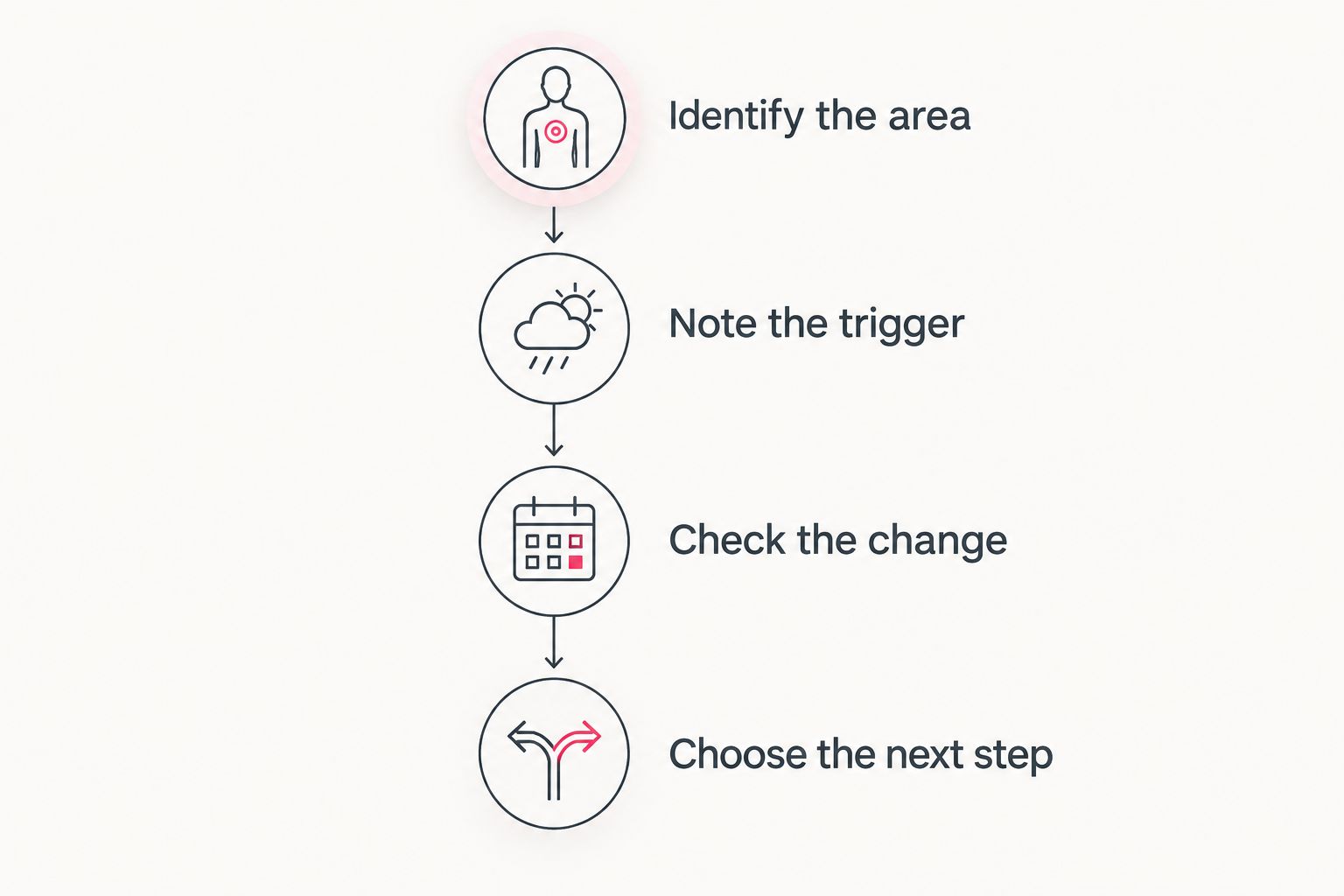
A brief record is more useful than repeatedly checking whether someone nearby looks dry. Include the effect on your day, such as needing a clothing change or having difficulty holding a pen.
What helps when wetness is the main concern?
Choose an antiperspirant for sweat reduction, deodorant for odor control, and a cleanser for washing away sweat and buildup. These functions are related, but they are not interchangeable.
From Duradry's sweat care perspective, the simplest useful routine starts with the problem you actually want to address. More products do not automatically mean better control.
Daily underarm wetness and odor
Best for: a straightforward daily underarm routine. The Clinical Sweat Control Stick combines antiperspirant and deodorant functions. Its advantage is addressing both underarm wetness and odor in a familiar format; its limit is that underarm protection does not establish treatment of sweating elsewhere or its underlying cause.
Apply the stick to clean, dry underarms using 2–4 swipes per underarm, following the current package directions. Do not keep adding layers to compensate for irritated skin or an unclear routine.
Heavier underarm sweating that needs a nighttime step
Best for: targeted nighttime support for heavier underarm sweating. The Intensive Sweat Minimizing Gel is an underarm antiperspirant applied at bedtime and washed off the following morning. Its advantage is focused nighttime sweat control; the tradeoff is an additional application schedule and the possibility of irritation.
Apply a pea-sized amount per underarm only when the skin is completely dry, not immediately after bathing. Avoid broken, irritated, or recently shaved skin. Wash thoroughly the next morning and dry the underarms before applying daytime protection.
Follow the current label for the initial schedule. After control is established, the referenced maintenance pattern is 2 applications per week or as needed—not a promise that two starting applications work for everyone.
The gel is not designed to treat sweating while asleep. Bedtime application supports less underarm sweat during the day; night sweats are a separate medical question.
Duradry antiperspirants are best for people seeking targeted sweat reduction within each product's labeled use. They are not a diagnosis or a treatment for an underlying cause of sweating. Stop use if rash or irritation occurs, and ask a doctor before antiperspirant use if you have kidney disease.
Why am I sweating even when I am not hot?
Sweating without feeling hot can reflect emotional triggers, primary hyperhidrosis, medications, or a health condition. The absence of heat does not identify the cause on its own.
If the pattern repeats while you are resting, note the affected areas and whether it is new. Persistent or disruptive symptoms deserve assessment rather than repeated product changes.
Does sweating more mean I am out of shape?
Sweating more does not, by itself, measure fitness. Heat exposure, exercise intensity, individual responses, and other factors affect how much moisture you notice.
Do not use a friend's dry shirt as a fitness benchmark. Judge an unexplained change in sweating separately from your workout performance.
When should I get medical help for sweating?
Arrange a medical assessment for new, unexplained, persistent, or disruptive sweating, especially recurring night sweats or sweating with fever, unexplained weight loss, or palpitations. These features need evaluation rather than a stronger personal care routine alone.
Seek emergency care when sudden sweating occurs with chest pain, significant shortness of breath, or fainting. Do not delay urgent help to troubleshoot an antiperspirant.
FAQ
Is it normal to sweat more than everyone around me?
Sweating more than people around you can reflect normal individual variation, especially during heat or exercise. Repeated sweating beyond cooling needs, disruption to daily life, or a new unexplained pattern warrants assessment.
How do I know whether I have hyperhidrosis?
A healthcare professional diagnoses hyperhidrosis using your symptoms, history, and examination. Note where you sweat, when it happens, whether it occurs during sleep, and how it affects ordinary activities.
Can anxiety make me sweat even in a cool room?
Emotional stress can trigger sweating even in a cool room. Sweating alone does not establish an anxiety disorder, and recurring symptoms outside stressful situations deserve their own assessment.
Why does deodorant leave my armpits wet?
Deodorant controls odor but does not necessarily reduce perspiration. If wetness is your concern, check whether your product is also labeled as an antiperspirant and follow its directions.
Should I stop my medication if it makes me sweat?
Do not stop or change prescribed medication on your own because of sweating. Tell your prescriber when the sweating started and whether it followed a dose or medication change.
Will a nighttime antiperspirant treat night sweats?
Nighttime antiperspirant application is not a treatment for night sweats. Duradry's underarm gel is applied at bedtime for daytime sweat control; recurring sweating during sleep deserves medical assessment.
Related guides
One last thing
The detail to pay attention to is not how dry someone else looks. It is whether your own sweating has changed. Start by recording the area, trigger, timing, and effect on your day; use that pattern to choose targeted care or prepare for a clinician's assessment.

