

Rideshare and delivery driver sweat control is a routine that separates sweat reduction, odor protection, and cleansing to help you stay comfortable while working. Choose an antiperspirant for rideshare drivers based on where you sweat and when you can apply it—not on fragrance alone.
- Duradry sweat care suits drivers who want daily underarm protection with a separate nighttime option for heavier sweating.
- Choose an antiperspirant for rideshare drivers to reduce wetness; deodorant alone addresses odor.
- Apply underarm products to clean, dry skin before work, not over active sweat between pickups.
- Use body antiperspirant wipes only on permitted areas and follow their application and wash-off directions.
Why sweat control matters for rideshare and delivery drivers
Your workday can combine sitting in a vehicle, walking deliveries, carrying orders, and stepping between indoor and outdoor temperatures. A routine needs to fit those transitions without requiring a full reset after every stop.
Wetness and odor need different solutions. Antiperspirant reduces perspiration in the treated area; deodorant addresses odor. If you already use deodorant but your shirt still feels wet, changing the scent does not address that mismatch. The guide to using antiperspirant and deodorant together explains the distinction.
Start with the concern that interrupts your shift. Underarm wetness, sweaty feet, and body odor are not interchangeable, and a product labeled for underarms does not automatically belong on your hands or back.
Build a sweat care routine around your driving schedule
1. Identify the area and concern you want to address
Before adding products, separate what you notice into wetness, odor, or both. Your existing routine might already cover one concern while leaving the other unchanged.
Think about a typical shift rather than your hottest delivery of the month. Ordinary sweating during physical activity does not automatically mean you have a medical condition. The useful question is whether your current care matches the body area and the problem.
- Note whether the concern is underarms, hands, feet, chest, or back.
- Separate visible dampness from odor after clothing dries.
- Check whether your current product says antiperspirant, deodorant, or both.
- Notice whether sweating starts before work or mainly during active deliveries.
- Record any itching, rash, or irritation rather than treating it as normal.
2. Arrange application around sleep and preparation time
Build the routine at home first. A clean shirt, dry skin, and enough time to follow product directions are more useful than repeatedly applying a product over sweat in a parking lot.
If your work runs into the evening, distinguish bedtime from the start of your shift. A nighttime antiperspirant has its own application and wash-off instructions; it is not simply a stronger product to apply whenever wetness appears. Follow the current label rather than improvising around pickups.
- Set aside application time when your skin is clean and completely dry.
- Keep cleansing separate from applying leave-on protection.
- Follow any restriction against application immediately after bathing.
- Plan morning wash-off when a nighttime product requires it.
- Keep all grooming and product application for times when you are safely parked or at home.
3. Start with daily underarm protection
For everyday underarm wetness and odor, begin with the simplest relevant format. Duradry's Clinical Sweat Control Stick is an underarm antiperspirant and deodorant, so it addresses both concerns in a daily step.
Apply it to clean, dry underarms using the current package directions. The supplied product guidance specifies 2–4 swipes per underarm. Adding a heavier layer is not a substitute for correct timing or dry skin.
The stick has lightly scented options, not a fragrance-free formula. That distinction matters if you prefer minimal scent in a shared vehicle. Its daily format is straightforward, but it remains an underarm product—not a treatment for sweaty palms or feet.
- Use the stick on underarms only.
- Start with clean, dry skin rather than damp skin after a shower.
- Follow the labeled application amount instead of adding repeated layers.
- Choose fragrance according to your preference, not as a measure of sweat control.
- Stop use if rash or irritation occurs.
4. Add nighttime support only when your underarms need it
If daily protection does not adequately address heavier underarm sweating, consider a separate nighttime step. The Intensive Sweat Minimizing Gel is designed for bedtime underarm application and wash-off the next morning.
The gel is not designed to treat night sweats. Bedtime application supports sweat control during the day; it does not establish treatment for sweating during sleep or its underlying causes.
The application sequence is: Cleanse, Dry completely, Apply at bedtime, Wash off, Apply daytime stick. Use a pea-sized amount per underarm according to the current label, and do not apply immediately after bathing or to recently shaved, broken, or irritated skin.
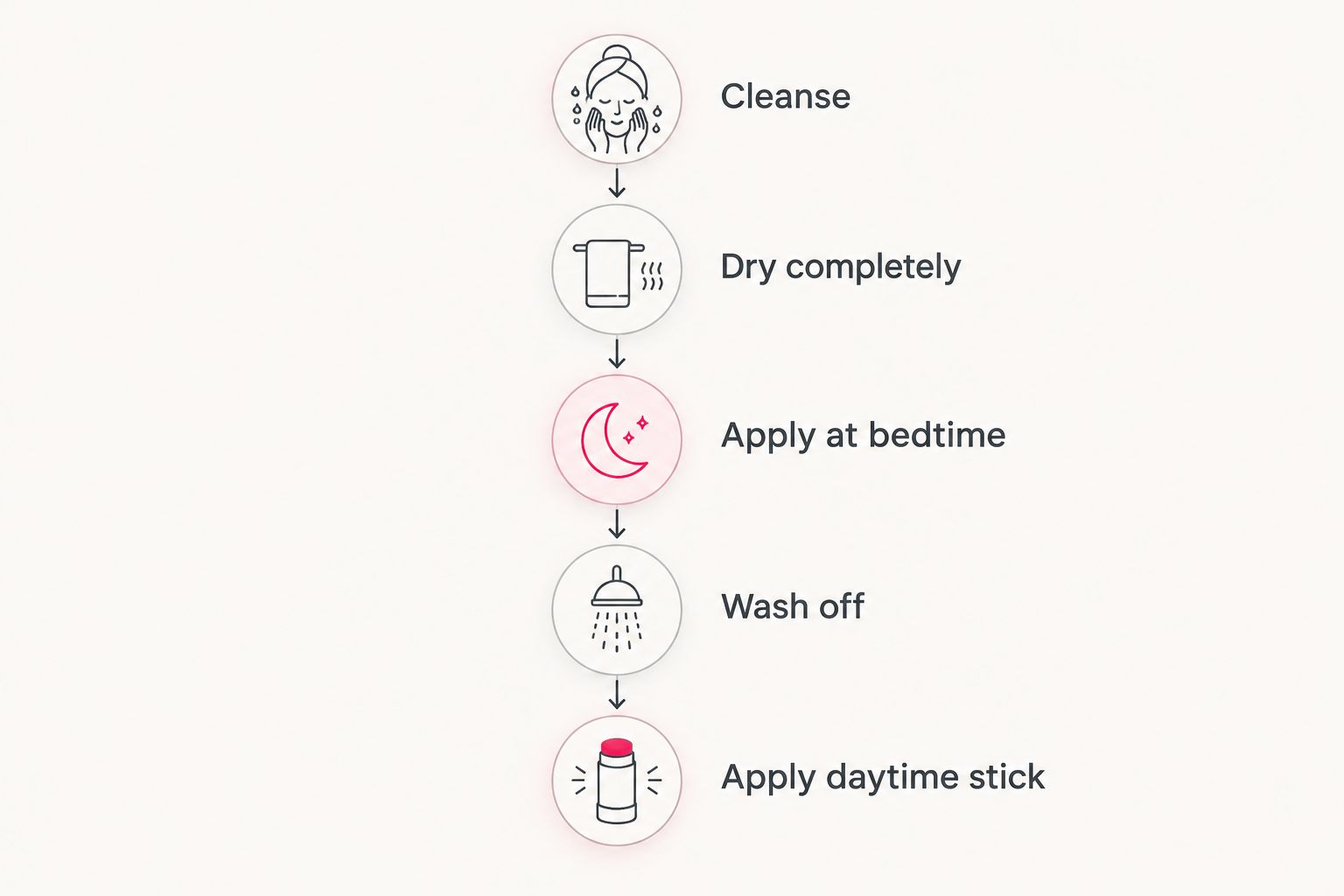
Follow the initial schedule on your current package. A maintenance pattern of 2 nights per week applies only after control is established and when consistent with the label; it is not a universal starting schedule. Ask a doctor before antiperspirant use if you have kidney disease, and stop for rash or irritation.
- Cleanse: remove sweat and residue, then rinse thoroughly.
- Dry completely: respect the restriction against immediate post-bathing application.
- Apply at bedtime: use the labeled amount on underarms only.
- Wash off: thoroughly wash the underarms the next morning.
- Apply daytime stick: dry the underarms before daily protection.
5. Match body care to the area you actually need to treat
Body sweat calls for body-appropriate directions. Do not move an underarm-only gel onto your hands because you want a better grip on the steering wheel.
Sweat Control Body Wipes are antiperspirant wipes positioned for targeted areas including hands, feet, chest, back, thighs, and underarms, subject to the current package directions. The supplied reference lists 30 unscented wipes per pack. They are not simply cleansing wipes for wiping away sweat after a delivery.
Their directions emphasize clean, dry skin and nighttime application, with air drying and morning wash-off. Follow the pack for any permitted daytime use. If your concern is odor rather than wetness, Deodorant Body Spray serves a different purpose: leave-on body odor protection, not clinical sweat reduction.
- Check that the specific product permits your intended body area.
- Follow the wipe's application timing and wash-off instructions.
- Keep antiperspirant away from the face and mucous membranes.
- Let treated hands dry fully before touching driving controls.
- Choose odor care only when odor—not reduced perspiration—is the goal.
6. Pack for a practical refresh, not repeated layering
A useful shift kit supports comfort without turning the vehicle into your bathroom. Start with what you already own: a clean spare shirt, a clean towel, and a way to separate damp clothing from clean belongings.
For delivery work, changing out of a damp shirt during a suitable break addresses the clothing itself. It does not replace antiperspirant, but it avoids treating every damp patch as a reason to apply more product.
Store sweat care according to package instructions rather than assuming a hot parked car is suitable storage. Keep products away from driving controls, food orders, and passenger belongings.
- Pack a clean spare top suited to your work clothes.
- Keep a clean towel for drying skin during a break.
- Separate used clothing from clean supplies.
- Check storage directions before leaving products in the vehicle.
- Apply products only while safely parked and where you can follow the directions.
7. Review the routine before increasing it
Judge whether the routine addresses your original concern. Less underarm wetness does not mean your feet will also stay dry, and a fresher scent does not prove sweat reduction.
If protection falls short, check the basics before adding another layer: product category, permitted area, dry skin, timing, and consistency. Avoid combining gel, stick, and body wipes on the same skin at once to seek a stronger effect.
Persistent or disruptive sweating deserves a clinician's assessment, especially if it starts suddenly, occurs during sleep, or comes with other symptoms. A consumer routine does not establish the cause.
- Compare the same concern across similar work conditions.
- Check application directions before increasing the amount.
- Remove unnecessary steps if they do not serve your main need.
- Stop a product that causes rash or irritation.
- Seek professional advice for persistent problems or a sudden change.
Compare your options by job, not format
These are Duradry product roles, not an independent product ranking. The best starting point is the option that addresses your main concern with the fewest necessary steps.
Daily stick: best for everyday underarm wetness and odor
Clinical Sweat Control Stick combines an antiperspirant and deodorant in a familiar daily format. Its advantage is addressing both concerns without introducing a separate nighttime schedule.
Limitation: it is for underarms only, and its scented options do not suit someone specifically seeking fragrance-free underarm care.
Nighttime gel: best for heavier underarm sweating
Intensive Sweat Minimizing Gel adds targeted bedtime sweat control. It fits a driver who needs more underarm support than a basic daily routine provides.
Limitation: it requires dry-skin preparation, a separate application schedule, and morning wash-off. It is not for hands, feet, or treatment of night sweats.
Antiperspirant wipes: best for targeted body sweat
Sweat Control Body Wipes offer a portable antiperspirant format for permitted body areas. Their broader application role distinguishes them from an underarm-only gel.
Limitation: portability does not mean instant protection over active sweat. The disposable format also requires following application and wash-off directions rather than using it like a cleansing towel.
Deodorant spray: best for body odor without a sweat-reduction goal
Deodorant Body Spray provides unscented, leave-on odor protection. That makes it a relevant option when you want odor care without a competing fragrance.
Limitation: it is not a substitute for an antiperspirant when your goal is less wetness. Use it only on areas permitted by the current directions.
Body wash: best for removing sweat and product buildup
Deep Clean Body Wash is the rinse-off cleansing step. It removes sweat, odor, and daily buildup, including antiperspirant residue.
Limitation: cleansing does not prevent new perspiration. A branded wash is not a prerequisite for every antiperspirant routine.
Common mistakes rideshare and delivery drivers make
- Choosing fragrance instead of function. A stronger scent does not turn a deodorant into an antiperspirant. Check the product category before replacing something that leaves your shirt wet.
- Using an antiperspirant wipe as a quick cleanup towel. Removing sweat and applying sweat control are different tasks. Follow the wipe's dry-skin and timing instructions rather than assuming a post-delivery wipe-down completes the routine.
- Treating the whole body with an underarm product. Sweaty hands or feet need a product labeled for those areas. The gel's underarm directions do not expand because you are working a long shift.
- Keeping products permanently in a parked car. Check package storage requirements and carry products appropriately. A convenient location is not automatically a suitable storage environment.
- Adding more product without checking irritation or timing. Repeated layering does not correct damp-skin application. Stop for rash or irritation instead of pushing through it.
FAQ
What's the best antiperspirant for rideshare drivers?
The best starting point is an underarm antiperspirant that matches your wetness and odor needs. Duradry's Clinical Sweat Control Stick provides daily underarm sweat and odor protection; heavier underarm sweating can call for a separate nighttime step.
Should I apply antiperspirant before driving or during a break?
Apply antiperspirant when you can follow its directions on clean, dry skin. For a daily underarm product, preparation before work is more practical than layering it over sweat between pickups; nighttime products have a separate schedule.
Can I use sweat control wipes on my hands before driving?
Use only an antiperspirant wipe whose current directions permit hand application. Follow its timing instructions and let your hands dry fully before touching driving controls; an underarm-only gel is not an alternative.
Will body deodorant keep my shirt dry during deliveries?
Body deodorant addresses odor, not perspiration reduction. Choose an antiperspirant permitted for the relevant body area when your main concern is wetness.
Can I leave antiperspirant in my car between shifts?
Follow the storage instructions on the current package. Do not assume a hot parked vehicle provides suitable storage simply because the product is convenient to carry.
Does nighttime sweat gel treat sweating while I sleep?
Intensive Sweat Minimizing Gel is not designed to treat night sweats. Its bedtime application supports daytime underarm sweat control; new or persistent sweating during sleep warrants medical advice.
What should I do if my antiperspirant stings or causes a rash?
Stop use if rash or irritation occurs, as the antiperspirant labels direct. Do not apply more or continue through worsening symptoms; seek professional advice for persistent or severe reactions.
One last thing
A shift kit cannot fix a product-category mismatch. Before buying another item, check whether the product you already use says antiperspirant or deodorant. If wetness is the problem, that distinction is your next decision—not a different fragrance.

