

Witch hazel for armpits is not a dependable way to reduce sweat, and it is not an established replacement for deodorant to control odor. It can leave skin feeling temporarily less oily or damp, but that sensation does not establish sweat reduction. Alcohol, fragrance, and other ingredients in the formula can also irritate underarm skin, especially after shaving.
- Witch hazel for armpits is not a substitute for antiperspirant when underarm wetness is your concern.
- Witch hazel's drying sensation does not establish lasting body odor protection.
- Choose deodorant for odor control, antiperspirant for sweat reduction, and a cleanser to remove buildup.
- Duradry Clinical Sweat Control Stick fits daily underarm sweat and odor care; it is not an irritation-free guarantee.
Does witch hazel help with armpit sweat or odor?
Do not rely on witch hazel to stop armpit sweat or provide dependable odor protection. Its role as an astringent—a product that creates a temporary tightening or drying sensation on skin—is different from an antiperspirant's sweat-reducing function.
Separate the problem before choosing a product:
- Wet patches: Choose an underarm antiperspirant labeled to reduce perspiration. Witch hazel is not a substitute for that function.
- Odor without bothersome wetness: Choose deodorant and keep a consistent cleansing routine. A temporary fresh feeling does not establish lasting odor control.
- Sweat and product residue already on skin: Wash, rinse, and dry the area. Adding another leave-on product is not the same as cleansing.
Underarm odor develops when skin bacteria break down components of sweat and other skin secretions. That is why removing existing odor and managing odor between washes are separate tasks. The distinction also explains how to get rid of underarm odor without treating every odor concern as excessive sweating.
Why this matters
A dry feeling and reduced sweating are not interchangeable. You can wipe your underarms, feel fresher briefly, and still sweat through your shirt during a commute or presentation.
Choosing the wrong product creates unnecessary trial and error. If wetness is the issue, switching between facial toners does not address the same need as an antiperspirant; if odor is the issue, stronger sweat control is not automatically your only option.
You also do not need to make ordinary sweating a medical problem. Start with the concern that affects your comfort, then choose the smallest routine that addresses it.
What witch hazel can—and cannot—do for your underarms
Witch hazel: optional skincare, not sweat protection
Witch hazel appears in astringent skincare products. Some formulas contain alcohol or fragrance, while others do not, so the ingredient name alone tells you little about how the finished product will feel on your underarms.
Its practical limitation is straightforward: a drying sensation is not proof that less sweat is reaching your skin. Nor does the word astringent establish that a product will control underarm odor throughout your day.
- Best for: Someone considering an optional skincare step, provided the product directions permit the intended use and the skin tolerates it.
- Advantage: Some people like the temporary less-oily feeling.
- Limitation: It does not replace a labeled antiperspirant or establish dependable deodorant performance.
Deodorant: best for odor without a dryness goal
Deodorant addresses odor. It does not necessarily reduce how much you sweat, so check whether the package also identifies the product as an antiperspirant.
This distinction matters when your underarms smell fine but your clothing still feels wet. The deodorant has not necessarily failed; you are asking it to do a different job.
- Best for: Odor that bothers you more than wetness.
- Advantage: Targets the concern without automatically adding intensive sweat control.
- Limitation: A deodorant-only formula does not establish perspiration reduction.
Antiperspirant: best for underarm wetness
Antiperspirants use sweat-reducing active ingredients. Products labeled as both antiperspirant and deodorant address wetness and odor, though their directions and individual skin tolerance still matter.
You do not need a diagnosis to choose an everyday antiperspirant. Work, exercise, warm weather, and social plans are ordinary reasons to want less underarm wetness.
- Best for: Wet patches, damp underarms, or combined sweat and odor concerns.
- Advantage: Provides the sweat-reducing function witch hazel does not replace.
- Limitation: Application conditions matter, and irritation is possible.
Why your experience with witch hazel varies
The bottle's full formula and the condition of your skin matter more than the ingredient's reputation. Consider these factors before interpreting a fresh or tight feeling as a result:
- Alcohol content: Alcohol-containing formulas can feel drying and can irritate skin. An alcohol-free label does not guarantee that a product will suit you.
- Fragrance and other ingredients: Your skin encounters the finished formula, not witch hazel in isolation. Review the ingredient list rather than assuming a botanical product is gentle.
- Recent shaving: Shaving can leave underarm skin more vulnerable to stinging and irritation. Do not apply products over cuts or irritated skin.
- Your actual goal: Removing residue, controlling odor, and reducing sweat require different functions. Success at one does not establish success at the others.
- Other products in the routine: Adding toner, deodorant, and antiperspirant together makes it harder to identify what caused discomfort. More layers do not establish better protection.
Judge a product by the job you need done, not by how strongly you feel it working. Stinging, tightness, or rapid evaporation is not a measure of sweat control.
How do you choose a routine instead?
Use the concern you notice during a normal day—not the number of products on your bathroom shelf—to decide where to start.
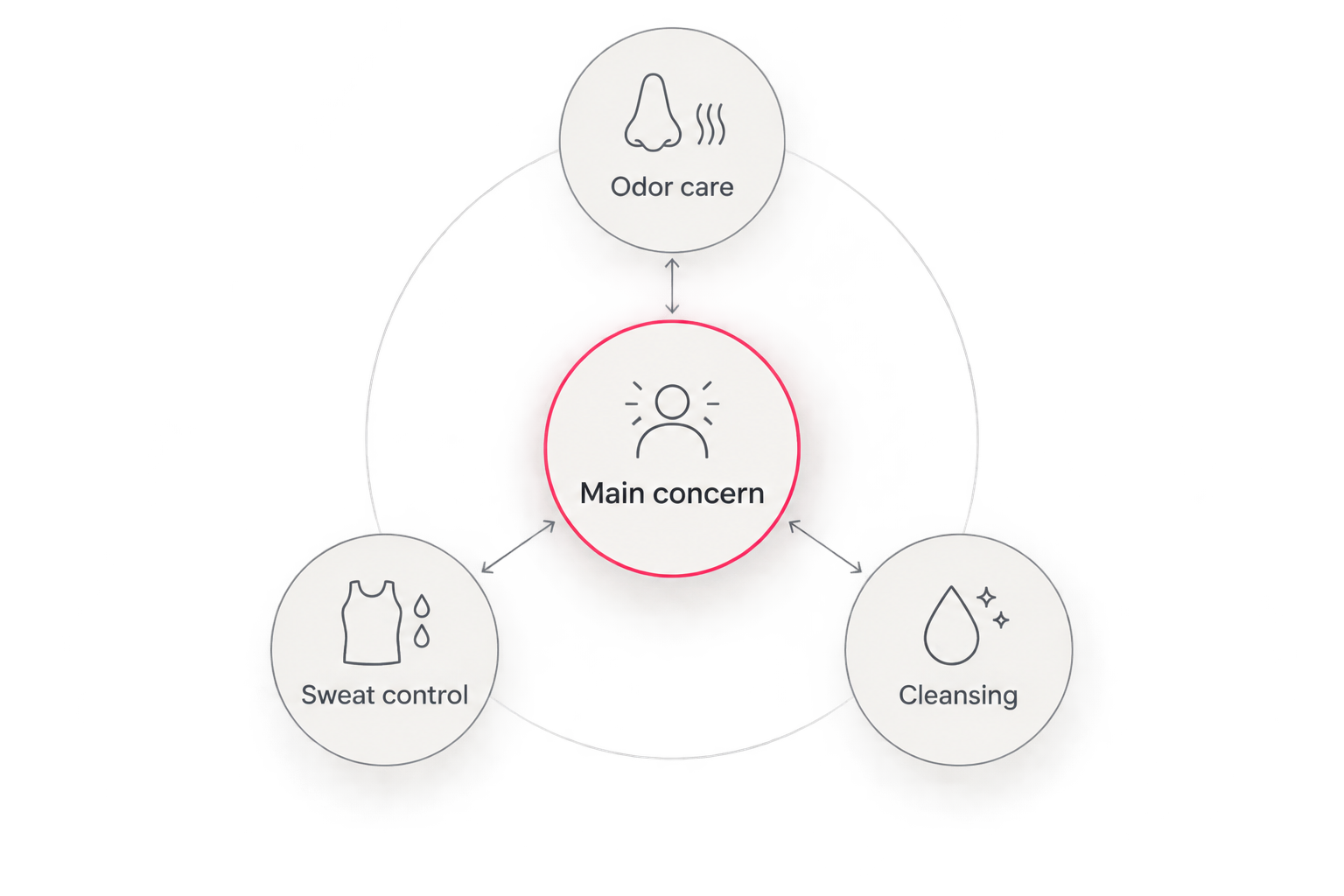
Start with the main concern
Choose odor care when smell is the problem, sweat control when wetness is the problem, and cleansing when sweat and residue need washing away. You can need more than one function without needing every available format.
Use daily protection for everyday wetness and odor
Duradry Clinical Sweat Control Stick is best for daily underarm sweat and odor protection. The Clinical Sweat Control Stick combines antiperspirant and deodorant functions in a familiar format.
The supplied product directions specify 2–4 swipes per underarm on clean, dry skin. Follow the current package label, including its warnings, rather than adding extra swipes because a busy day is ahead.
The advantage is a straightforward daily step. Its limitation is that no product is guaranteed to suit every person's skin or control every degree of sweating; stop if rash or irritation occurs.
Add nighttime support only when it serves a purpose
For heavier underarm sweating, the Intensive Sweat Minimizing Gel adds a separate bedtime antiperspirant step. It is best for people who need more focused underarm sweat control than their basic routine provides.
Apply the gel according to its current label on completely dry underarms, not immediately after bathing. Wash it off the next morning, dry your underarms, and then apply the daytime stick if it is part of your routine.
The gel's advantage is targeted nighttime application for less daytime sweat. Its limitations include an additional step, underarm-only directions, and restrictions around recently shaved, broken, or irritated skin. Bedtime application does not mean it treats sweating during sleep.
Duradry's sweat care routine separates daily protection from intensive nighttime support. You do not need to use both simply because both exist.


Keep cleansing separate from leave-on protection
If your underarms already have sweat, odor, or accumulated product on them, begin by washing rather than applying witch hazel over everything. Cleanse gently, rinse thoroughly, and let the skin dry before a leave-on product.
Choosing soap for daily cleansing addresses the wash step, not the separate question of how to reduce perspiration afterward. A cleanser's ingredients or fresh after-feel do not make it an antiperspirant.
The same distinction applies after a workout. Washing removes material already on your skin; deodorant addresses odor between washes, and antiperspirant reduces perspiration in the treated area. None of those roles requires an extra witch hazel step.
Keep washing comfortable, too. Scrubbing harder is not a strategy for making sweat glands less active, and a tight, uncomfortable after-feel is not a necessary sign of clean skin.
Can I use witch hazel before deodorant?
You do not need witch hazel before deodorant. Clean, dry skin and the deodorant's own directions are the more useful starting point.
If you already use witch hazel, check whether its directions permit your intended use, and avoid broken or irritated skin. Stop if it causes burning, rash, itching, or persistent discomfort; do not cover the reaction with more products.
Avoid introducing several new underarm products at once. Keeping the routine simple makes it easier to identify which product suits your skin and which one does not.
Is alcohol-free witch hazel better for sensitive armpits?
Alcohol-free witch hazel avoids alcohol as one possible source of dryness, but it is not an irritation-free guarantee. Fragrance, other ingredients, and your skin's condition still matter.
If your underarms are already sore, freshly nicked, or inflamed, adding another skincare step is not the priority. Let irritation settle and seek professional advice if it persists or worsens.
Do not assume that a botanical ingredient is gentler than every antiperspirant. Compare the finished formulas and directions, not a natural-versus-clinical label.
When should you ask a clinician about sweat or odor?
Persistent sweating that disrupts daily life deserves assessment, particularly when an appropriate routine is not enough. A clinician can distinguish ordinary sweating from hyperhidrosis or another cause and discuss treatment options.
Get medical advice for a sudden change in sweating, unexplained sweating during sleep, or sweating with other symptoms. Persistent odor accompanied by a rash, pain, or other skin changes also needs more than repeated product switching.
For antiperspirants, follow warnings about broken skin, irritation, and asking a doctor before use with kidney disease. Do not increase the dose, continue through a rash, or change prescribed treatment to accommodate a cosmetic routine.
FAQ
Does witch hazel stop armpit sweating?
Witch hazel is not a substitute for an antiperspirant to reduce underarm sweating. A temporary dry or tight feeling does not establish reduced perspiration.
Can witch hazel replace my deodorant?
Do not rely on witch hazel as a replacement for dependable deodorant protection. Choose a product formulated for odor control, and choose an antiperspirant if wetness also bothers you.
Does witch hazel kill the bacteria that cause armpit odor?
Do not assume a witch hazel toner provides reliable antibacterial odor control. An ingredient's reputation does not establish the finished product's performance on underarms.
Can I put witch hazel on my armpits after shaving?
Avoid applying witch hazel to freshly nicked, broken, or irritated underarm skin. Alcohol, fragrance, and other ingredients can sting or worsen irritation.
How often should I use witch hazel on my armpits?
There is no established underarm sweat-control schedule for witch hazel. Follow the specific product's directions rather than inventing a daily treatment routine.
Will witch hazel detox my armpits before switching deodorants?
You do not need a witch hazel detox before switching deodorants. Wash away residue, dry your skin, and follow the new product's directions.
Is Duradry a better choice than witch hazel for underarm wetness?
Duradry antiperspirants are the relevant choice for reducing underarm wetness because that is their labeled function. Witch hazel does not replace an antiperspirant, and individual results and skin tolerance still differ.
One last thing
Your skin does not need to feel tight for your sweat care routine to work. For your next step, decide whether the real issue is odor, wetness, or residue, then choose one product that addresses that job before adding another layer.

