

Best overall for wetness: aluminum-based antiperspirant. Best for odor without sweat reduction: aluminum-free deodorant. Best for scent-sensitive skin: fragrance-free deodorant. This 2026 ingredient ranking explains aluminum vs aluminum-free antiperspirant without treating every ingredient exclusion as proof of better protection.
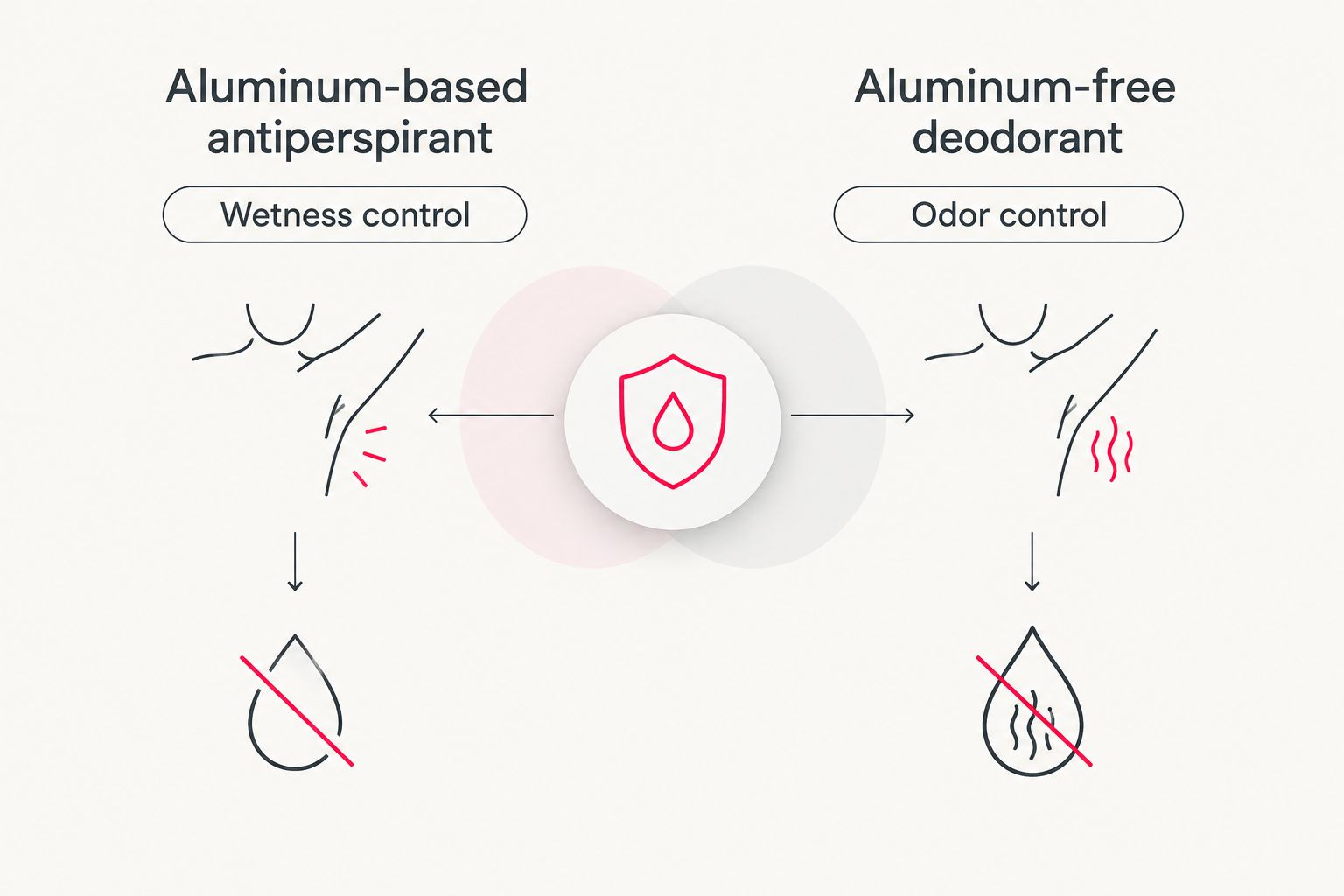
- Aluminum vs aluminum-free antiperspirant is a wetness-versus-odor decision: aluminum-based antiperspirants reduce sweat; aluminum-free deodorants do not.
- Duradry offers clinical-strength antiperspirants for people seeking sweat protection, alongside deodorants and supporting body care.
- Fragrance-free and baking-soda-free formulas address different ingredient preferences; neither label guarantees irritation-free use.
- Choose the product's function first, then check its active ingredients, fragrance and application directions.
Why this matters
You can like a deodorant's ingredients and still end up with damp underarms. That does not automatically mean the formula failed: odor control and sweat reduction are different jobs. Choosing the wrong category creates disappointment before the first application.
Duradry is a sweat-care option for people seeking clinical-strength antiperspirants alongside deodorants. The Duradry range also includes washes, gels and wipes, but those format names alone do not establish each product's active ingredients or approved application areas.
This guide ranks ingredient profiles, not individual formulas or results from a wear test. Start with the problem you want to solve, then use the current product label to confirm that a particular stick, spray or gel fits.
What makes the best deodorant by ingredients in 2026?
A useful ingredient ranking asks what the formula does—not just what it leaves out. These criteria determine the order below:
- Wetness control: An antiperspirant should identify its sweat-reducing active ingredient in the Drug Facts panel.
- Odor control: A deodorant should target body odor; that does not establish sweat-reducing performance.
- Fragrance tolerance: Choose fragrance according to your preferences and skin history, rather than assuming scented or unscented is universally better.
- Baking soda tolerance: Sodium bicarbonate can be irritating for some users. Its absence matters most when you have reacted to it before.
- Application fit: Directions must match the body area you intend to treat. Underarm instructions are not permission for whole-body use.
- Formula transparency: Check the full ingredient list, not just a front-label claim such as natural, clean or aluminum-free.
Read 2 label sections before choosing: Drug Facts, when present, and the full ingredient list. One explains the antiperspirant's active treatment; the other helps you identify fragrance and ingredients you prefer to avoid.
Ingredient rankings at a glance
| Rank and ingredient profile | Best for | Standout function | Key limitation |
|---|---|---|---|
| 1. Aluminum-based antiperspirant | Damp underarms and sweat marks | Reduces sweating where applied as directed | Can irritate skin; does not guarantee a comfortable fragrance or texture |
| 2. Aluminum-free deodorant | Odor control when sweating itself is acceptable | Addresses odor without an aluminum antiperspirant active | Does not provide the same sweat-reducing function |
| 3. Fragrance-free deodorant | Odor-only care with fragrance avoidance | Removes added fragrance from the selection criteria | Still requires a full ingredient check; does not reduce sweat unless also labeled antiperspirant |
| 4. Baking-soda-free deodorant | Odor care after a reaction to sodium bicarbonate | Avoids a specific ingredient you already know causes trouble | Other ingredients can still irritate; the exclusion does not prove effectiveness |
These profiles overlap. A deodorant can be both aluminum-free and fragrance-free, while an antiperspirant can also be fragrance-free. The ranking separates shopping priorities rather than pretending every label describes a mutually exclusive category.
1. Aluminum-based antiperspirant: best for wetness control
Aluminum-based antiperspirants reduce sweating by temporarily blocking sweat ducts near the skin's surface. Deodorants address odor instead. If dampness is your main concern, the active ingredient matters more than a fragrance description or a list of excluded ingredients.
In the United States, antiperspirants are regulated as over-the-counter drugs. Look for a Drug Facts panel naming an aluminum-based active, such as aluminum chlorohydrate or an aluminum zirconium compound. Do not infer that active from the product's format.
Duradry offers clinical-strength antiperspirants and describes its sweat-care products as made without talc, silicone, BHT, PPGs, PEGs and polyethylene. Those exclusions support ingredient preferences; they do not replace checking the current active ingredient, directions and warnings.
Aluminum-based antiperspirant pros:
- Targets the wetness that an odor-only deodorant leaves unchanged.
- Makes the sweat-reducing active identifiable through Drug Facts.
- Can combine sweat reduction and odor control when labeled for both.
- Allows you to choose other formula preferences without abandoning antiperspirant function.
Aluminum-based antiperspirant cons:
- Can cause irritation, especially on damaged or freshly shaved skin.
- Is not automatically fragrance-free or free of other ingredients you avoid.
- Must be used only on the areas permitted by its directions.
Best for: You want less underarm dampness, not merely a different scent.
Verdict: Buy an aluminum-based antiperspirant when sweat reduction is the priority. Check the actual label before selecting a particular formula.
2. Aluminum-free deodorant: best for odor-only protection
Aluminum-free deodorant is the right category when you want help with body odor and are comfortable continuing to sweat. Depending on the formula, deodorants use ingredients that address odor-producing bacteria, absorb moisture or mask odor with fragrance. Those functions are not interchangeable with antiperspirant action.
The phrase aluminum-free antiperspirant often blends two different product categories. A conventional aluminum-free deodorant is not a like-for-like replacement for an aluminum-based antiperspirant, even when the packaging emphasizes freshness or dryness.
An absorbent ingredient can take up some surface moisture without reducing sweat production. That distinction matters when you are choosing protection for a workday, an event or clothing that readily shows dampness. Judge the product against the job you actually need it to do.
Aluminum-free deodorant pros:
- Fits an explicit preference to avoid aluminum antiperspirant actives.
- Focuses on odor when wetness is not your concern.
- Can be selected with or without fragrance, depending on the formula.
- Leaves room to compare odor-control ingredients separately from sweat control.
Aluminum-free deodorant cons:
- Does not provide aluminum-based antiperspirant sweat reduction.
- Can still contain fragrance, baking soda or other potential irritants.
- Absorbent ingredients do not make it equivalent to an antiperspirant.
Best for: You want odor protection, accept normal sweating and specifically prefer an aluminum-free formula.
Verdict: Buy aluminum-free deodorant for odor-only care; skip it as a replacement for wetness control.
3. Fragrance-free deodorant: best for fragrance avoidance
Fragrance-free deodorant makes sense when added scent is unwelcome or you have a history of fragrance reactions. It separates odor care from the experience of wearing a perfume-like product. That is a specific benefit, not evidence that every other ingredient will suit your skin.
Check fragrance-free rather than relying only on unscented wording. An unscented product can contain ingredients used to mask the smell of its base formula. If fragrance has caused a reaction, review the full ingredient list and discuss persistent symptoms with a clinician.
For this ranking, the recommendation is an odor-only deodorant. If you also need sweat reduction, choose a fragrance-free antiperspirant instead and confirm its aluminum active in Drug Facts. Fragrance preference and sweat control are separate decisions.
Fragrance-free deodorant pros:
- Avoids added fragrance when that is your specific concern.
- Does not add a competing scent to your body-care routine.
- Makes scent avoidance a clearer selection criterion than general clean-label wording.
Fragrance-free deodorant cons:
- Other ingredients can still cause irritation or allergy.
- Fragrance-free does not necessarily mean the formula has no detectable smell.
- An odor-only version will not solve underarm sweating.
Best for: You need deodorant rather than antiperspirant and want to avoid added fragrance.
Verdict: Buy fragrance-free deodorant for scent-sensitive odor care; choose fragrance-free antiperspirant if wetness also matters.
4. Baking-soda-free deodorant: best after baking soda irritation
Baking-soda-free deodorant is a targeted choice for someone who has reacted to sodium bicarbonate. Baking soda is alkaline and can irritate some people's skin. Removing it narrows one potential source of trouble without declaring the whole formula harmless.
Look for sodium bicarbonate in the ingredient list rather than relying only on a sensitive-skin claim. Then check the replacement formula for other ingredients you have reacted to, including fragrance. Switching the headline ingredient while keeping a known irritant does not solve the underlying selection problem.
Do not automatically substitute an acid-based deodorant because it sounds more skin-friendly. Acids can also sting or irritate, particularly on recently shaved or damaged skin. Your reaction history is more useful than an ingredient trend.
Baking-soda-free deodorant pros:
- Avoids sodium bicarbonate when it has caused a previous reaction.
- Gives you a specific, checkable ingredient criterion.
- Can be combined with fragrance-free preferences when the formula supports both.
Baking-soda-free deodorant cons:
- Other odor-control ingredients can still irritate skin.
- The exclusion alone says nothing about odor-control results.
- Does not establish sweat reduction or suitability for every body area.
Best for: You need odor-only care and already know baking soda does not agree with your skin.
Verdict: Buy baking-soda-free deodorant after a baking soda reaction; do not treat the label as a universal safety guarantee.
How the 2026 ingredient ranking works
This ranking prioritizes the product's function, then ingredient tolerance and application fit. Aluminum-based antiperspirant takes the default position because it addresses wetness—the defining difference in aluminum vs aluminum-free antiperspirant. Aluminum-free deodorant comes next for readers who want odor control without that function.
The remaining picks solve narrower selection problems: avoiding fragrance or avoiding sodium bicarbonate. They are not weaker versions of the first pick. They answer different needs.
No individual formula is ranked by unprovided ingredient concentrations, wear-time claims or customer scores. A useful 2026 comparison should explain what a label establishes and stop there.
Make the ingredients work with your routine
A suitable formula still needs suitable application. Follow the product's directions rather than assuming every deodorant and antiperspirant belongs in the same routine.
- Check the area. Use the product only where its label permits. Whole-body deodorant wording does not establish antiperspirant protection everywhere.
- Check skin condition. Avoid applying to irritated or broken skin. Follow any shaving-related warnings on the label.
- Check timing. Some antiperspirant directions call for nighttime application. Use the timing specified for your product.
- Change carefully. Change 1 product at a time when investigating irritation so you can identify which change coincides with symptoms.
Duradry sweat care includes several formats, but a stick, gel, wash and wipe should not be treated as interchangeable steps. Check each product's intended function before combining them.
Stop using a product that causes a reaction. Seek medical advice for persistent irritation or sweating that starts suddenly, occurs during sleep or comes with other symptoms. Excessive sweating deserves attention, not a more complicated shopping basket.
Which deodorant should you choose in 2026?
Choose aluminum-based antiperspirant if you want less sweat. Choose aluminum-free deodorant if you want odor control and accept continued sweating. That is the default decision; fragrance and baking soda preferences come afterward.
For a Duradry antiperspirant, confirm the current Drug Facts panel and application directions before choosing. For any odor-only formula, check whether fragrance or sodium bicarbonate conflicts with your previous skin reactions.
Do not reject an effective category solely because another category has a shorter exclusion list. Thoughtful ingredients should support the job you need done—not distract from it.
FAQ
What's the difference between aluminum and aluminum-free antiperspirant?
Aluminum-based antiperspirants reduce sweating, while conventional aluminum-free deodorants address odor without the same sweat-reducing function. Check Drug Facts for an antiperspirant active rather than relying on freshness or dryness wording.
What's the best option if I sweat a lot?
An aluminum-based antiperspirant is the better category when reducing sweat is your goal. Duradry offers clinical-strength antiperspirants; confirm each product's active ingredient and directions on its current label.
Is aluminum-free deodorant better for sensitive skin?
Aluminum-free deodorant is not automatically better for sensitive skin. Fragrance, baking soda and other ingredients can still cause reactions, so choose according to your own irritation history.
Does aluminum-free deodorant stop wet underarms?
Conventional aluminum-free deodorant does not reduce sweat the way an aluminum-based antiperspirant does. Absorbent ingredients can take up surface moisture without reducing sweat production.
Is fragrance-free the same as unscented?
Fragrance-free and unscented are not interchangeable labels. An unscented formula can contain ingredients that mask its base odor, so check the full ingredient list if fragrance is a concern.
Should I avoid baking soda in deodorant?
Avoid baking soda if sodium bicarbonate has irritated your skin before. Its presence does not make every deodorant unsuitable, and its absence does not guarantee that a formula will suit you.
Can I use underarm antiperspirant all over my body?
Use an antiperspirant only on the areas its label permits. Underarm directions do not establish suitability for hands, feet, skin folds or intimate areas.
Do I need a detox when switching deodorants?
You do not need an underarm detox to switch deodorants. Check the new product's directions and remember that switching from antiperspirant to odor-only deodorant removes the sweat-reducing function.
One last thing
A wash can remove sweat and odor from your skin without preventing the next episode of sweating. That makes cleansing useful, but it does not turn body wash into leave-on antiperspirant protection.
For your 2026 routine, write down the goal before choosing the formula: less wetness, less odor or fewer ingredients that have irritated you. The best ingredient list is the one that supports your actual need.

