

Best overall for odor: Duradry Deodorant Body Spray. Best for sweat control beyond underarms: Sweat Control Body Wipes. Best shower step: Deep Clean Body Wash. Best introductory routine: Body Care Starter Kit. This 2026 guide compares whole body deodorants and supporting sweat-care options by what they actually do—not by treating every product as interchangeable.
- Duradry Deodorant Body Spray is the best whole body deodorants pick here for lightweight, unscented odor care.
- Sweat Control Body Wipes target perspiration; deodorant and antiperspirant solve different problems.
- Deep Clean Body Wash removes sweat, buildup, and odor during cleansing; it is not a leave-on deodorant.
- Choose Body Care Starter Kit for an introductory full-body sweat and odor routine, not an isolated concern.
Why this matters
You can feel freshly showered and still notice odor later. You can also smell fine while feeling uncomfortably damp. Those are different concerns, and the right product choice starts with separating them.
Deodorant addresses odor. Antiperspirant reduces perspiration. A wash cleans away sweat and buildup, but its place in your routine differs from a product you leave on your skin.
For your 2026 shopping shortlist, choose the function before the format. A spray is not automatically a sweat treatment, and a wipe is not automatically just a quick clean-up.
Duradry whole body deodorants and supporting sweat-care products suit people looking for odor care plus separate options for perspiration beyond underarms. This ranking stays within those supplied options; it is not a claim that they outperform every deodorant on the market.
What makes the best whole body deodorants
A useful whole-body product fits your concern, your application area, and the way you prefer to get ready. Use these criteria before choosing from the table:
- Correct function: Choose odor protection for odor, sweat control for dampness, and cleansing for removing sweat and buildup.
- Approved application areas: Follow the individual label. Whole-body positioning is not permission to use a formula on every body surface.
- Comfortable format: Spray, wipe, wash, and routine kit serve different moments. Pick the one you will use as directed.
- Thoughtful ingredients: Read the full ingredient list rather than treating a natural-origin percentage as a safety guarantee.
- Fragrance fit: Unscented makes sense when you do not want another scent in your routine. Fragrance preference is personal.
- Clear limits: Separate a product's described purpose from a promised wear time. All-day freshness is a goal, not an automatic result.
For a 2026 purchase, these criteria are more useful than a long list of unfamiliar ingredients without context. Your skin response and the product's directions matter more than a reassuring phrase on its own.
Whole-body options at a glance
The order below follows distinct use cases. Only the spray is the direct deodorant pick; the remaining products support sweat control, cleansing, or a broader routine.
| Rank and item | Best for | Standout feature | Key limitation |
|---|---|---|---|
| 1. Deodorant Body Spray | Lightweight odor care | Unscented, fine, fast-drying spray | Deodorant is not the same as perspiration control |
| 2. Sweat Control Body Wipes | Sweat control beyond underarms | Clinical-strength wipes described for full-body use | Application still needs to follow site-specific directions |
| 3. Deep Clean Body Wash | Shower-based cleansing | Designed to wash away sweat, buildup, and odor | Rinse-off cleansing does not replace leave-on protection |
| 4. Body Care Starter Kit | Starting a broader routine | Introductory full-body sweat and odor care | A kit is unnecessary if you only need one targeted step |
1. Deodorant Body Spray: best for lightweight odor care
Duradry Deodorant Body Spray is the default choice here when odor—not wetness—is your main concern. Its product description identifies an unscented, lightweight, fine spray with a fast-drying finish and 98% naturally derived ingredients.
That combination gives you a clear reason to choose it: you want odor care without adding fragrance. It also keeps the buying decision simple. You do not need to start with a kit if a single deodorant step addresses your concern.
Deodorant Body Spray pros:
- Unscented, so it does not add another fragrance to your routine.
- Fine spray format for people who prefer spraying to a stick or wipe.
- Fast-drying and lightweight, as described in the product information.
- A stated 98% naturally derived ingredient content for shoppers comparing formulation preferences.
Deodorant Body Spray cons:
- Odor protection is not a substitute for an antiperspirant when dampness is the problem.
- Unscented will not satisfy someone specifically shopping for a fragranced body-care experience.
- The natural-origin percentage alone does not establish that the formula suits sensitive skin.
Best for: People who want an unscented, lightweight deodorant step rather than a full sweat-control routine.
The 2026 buying rule is straightforward: select the spray for its described odor-care role, not because you assume it will stop perspiration. If you want scent, sweat reduction, and odor protection, identify those needs separately before deciding what to combine.
Verdict: Buy for lightweight, unscented odor care; skip as your only answer to excessive wetness.
2. Sweat Control Body Wipes: best for perspiration beyond underarms
Sweat Control Body Wipes are described as clinical-strength sweat control in a discreet wipe. The supplied product information names full-body use, including underarms, hands, feet, chest, and back.
These wipes belong in this guide because freshness is not only about smell. If perspiration is what interrupts your day, an odor-only product addresses the wrong concern. The wipe's stated sweat-control role distinguishes it from the deodorant spray.
Sweat Control Body Wipes pros:
- Designed for sweat control rather than only an added fresh scent.
- Wipe format offers an alternative to a spray or stick.
- Explicitly described for use beyond underarms.
- Product information names hands, feet, chest, and back as application areas.
Sweat Control Body Wipes cons:
- Sweat control and deodorant are different functions; choose according to the concern you want to address.
- A full-body description does not remove the need to follow warnings and application directions.
- Wipes are not a replacement for washing away accumulated sweat and buildup.
Best for: People seeking a sweat-control format for label-approved areas beyond the underarms.
Before using the wipes, check how and where the product directs you to apply them. Do not borrow instructions from another antiperspirant, and do not assume that instructions for underarms apply unchanged to every other area.
Verdict: Buy when perspiration beyond underarms is the priority; skip if you only want a scented deodorant.
3. Deep Clean Body Wash: best for the shower step
Deep Clean Body Wash is designed to wash away sweat, buildup, and odor without stripping your skin. Its role is cleansing—the beginning of a routine, not a replacement for a leave-on deodorant or antiperspirant.
Choose it when you want to address what is already on your skin during your shower. Then make a separate decision about the protection you need afterward. That distinction prevents you from expecting a rinse-off product to do a leave-on product's job.
Deep Clean Body Wash pros:
- Targets sweat, buildup, and odor during cleansing.
- Fits into a shower step rather than requiring a separate application format.
- Described as cleansing without stripping the skin.
- Serves a distinct role alongside either odor care or sweat control.
Deep Clean Body Wash cons:
- It is a rinse-off wash, not a whole-body deodorant.
- Cleansing alone is not the same as ongoing perspiration reduction.
- It does not replace a separate leave-on step when that is what your concern requires.
Best for: People who want a cleansing foundation before choosing targeted odor or sweat protection.
You do not need to treat normal body odor as a sign that you are unclean. Sweat and skin bacteria interact, and odor can return after washing. Choose the wash for cleansing, then judge any leave-on product by its own function.
Verdict: Buy for shower-based sweat and buildup removal; skip as a stand-alone deodorant replacement.
4. Body Care Starter Kit: best for beginning a broader routine
Body Care Starter Kit is described as an introductory kit for full-body sweat and odor protection. It belongs here for the reader who wants a routine rather than a single application format.
Start with a kit only when the broader approach matches your needs. If your sole concern is occasional odor, the deodorant spray is the more direct choice. If wetness is the issue, prioritize a sweat-control product and its directions.
Body Care Starter Kit pros:
- Positioned as an introduction to body care.
- Addresses full-body sweat and odor at the routine level.
- Offers a kit format for people who prefer choosing a routine together.
Body Care Starter Kit cons:
- A broader routine adds complexity when you only need one targeted step.
- A kit does not make every included formula appropriate for every application area.
- Starting several unfamiliar products together makes it harder to identify which one causes irritation.
Best for: People building an introductory sweat-and-odor routine rather than replacing one deodorant.
Treat the kit as a collection of individual products with individual directions. Read each label, and avoid applying multiple unfamiliar formulas to the same area at once simply because they arrived together.
Verdict: Buy for a broader introductory routine; skip when one clearly chosen product is enough.
Build your routine around the concern
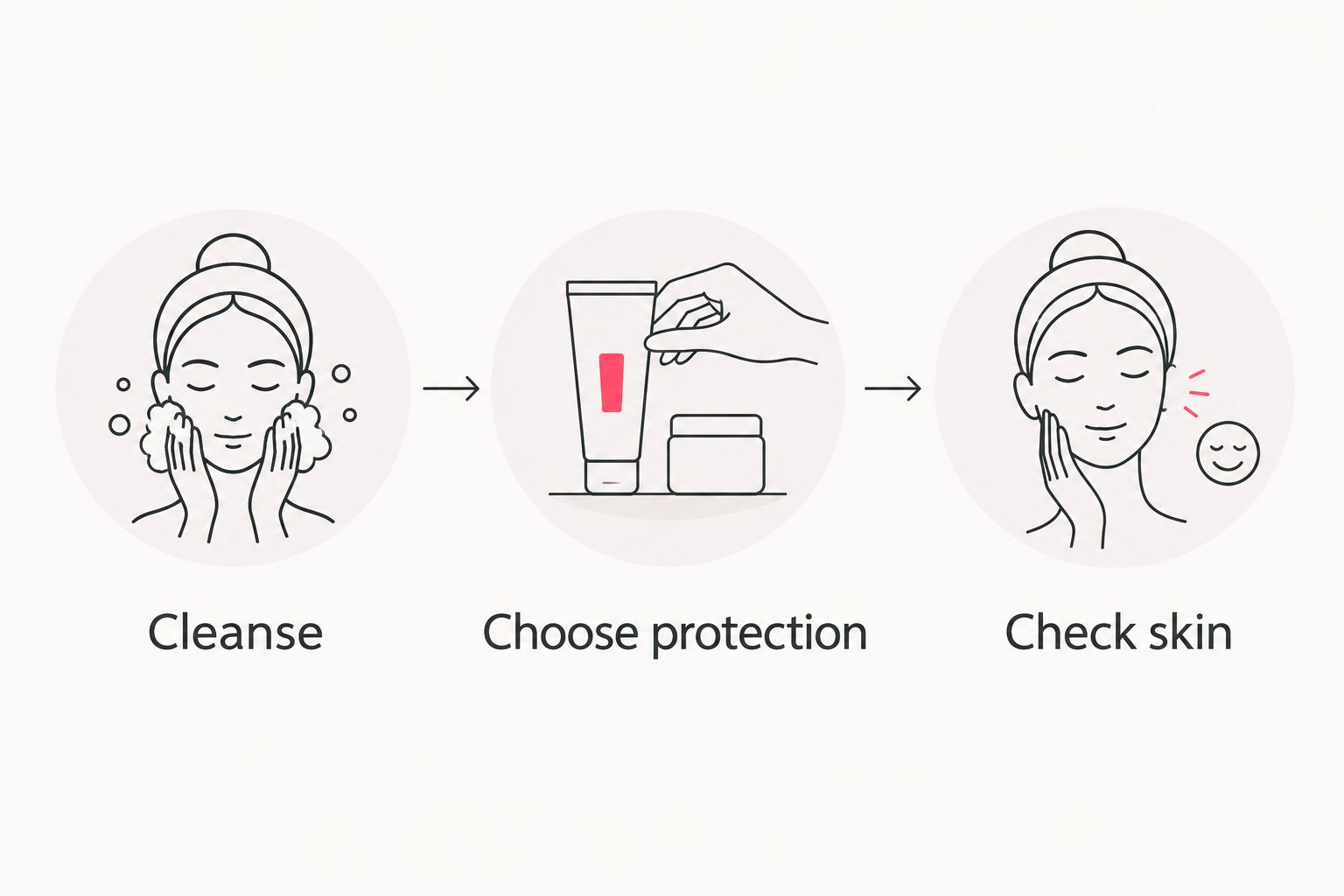
Use these 3 steps to keep whole-body care practical. You are choosing between 2 goals—odor care and perspiration control—after deciding what needs cleansing.
Cleanse
Wash away sweat and buildup, then dry your skin before applying a leave-on product according to its instructions. Deep Clean Body Wash fills the cleansing role in this shortlist; it does not decide what protection you need afterward.
Choose protection
Pick Deodorant Body Spray when odor is your priority. Pick Sweat Control Body Wipes when perspiration is the concern and the application area is permitted by the label. Do not automatically layer both everywhere.
Check skin
Introduce an unfamiliar product cautiously and follow its directions. Stop using a product that causes irritation rather than covering the reaction with another formula. More product is not a better plan for irritated skin.
For a 2026 routine, begin with the smallest set of products that has a clear purpose. The spray and wipes below represent different protection choices, not an instruction to use both together.


How the ranking works
This ranking prioritizes a direct match between concern and function, followed by application format, stated formulation details, and the limits of each option. The spray ranks first because it directly matches the whole-body deodorant query; the wipes rank next for readers whose actual concern is perspiration.
The wash and kit occupy supporting slots rather than competing as interchangeable deodorants. No measured wear-time comparison is part of this ranking, and the order does not establish a clinical performance advantage between products.
Which whole-body option should you choose?
Choose Duradry Deodorant Body Spray for lightweight, unscented odor care. It is the clearest default for someone shopping for a deodorant rather than a sweat treatment.
Choose Sweat Control Body Wipes instead when dampness beyond underarms is the concern. Add a cleansing step for sweat and buildup, and choose a starter kit only when you want a broader routine.
Your 2026 shortlist should get shorter once you identify the problem. A product that matches your concern is more useful than a complicated routine assembled around the word freshness.
FAQ
What's the best whole-body deodorant in this guide?
Duradry Deodorant Body Spray is the best pick in this guide for lightweight, unscented odor care. It is described as a fine, fast-drying spray; choose a sweat-control option instead when perspiration is your main concern.
Do whole body deodorants stop sweating?
Deodorants address odor; antiperspirants reduce perspiration. Check the individual product's function rather than assuming whole-body positioning means sweat control.
Is a deodorant spray better than sweat-control wipes?
Deodorant Body Spray is the better match for odor care, while Sweat Control Body Wipes are the better match for perspiration control. They serve different purposes, so choose according to your concern and the label-approved application area.
Can I use whole-body deodorant on intimate areas?
Use a product on intimate areas only when its label explicitly permits that application. Whole-body wording is not permission to apply it internally or to mucous membranes; follow all warnings and directions.
Does naturally derived mean a deodorant is safe for sensitive skin?
A naturally derived ingredient percentage does not establish suitability for sensitive skin. Review the full ingredient list, follow application instructions, and stop using a product that causes irritation.
Can body wash replace whole-body deodorant?
Body wash does not replace a leave-on deodorant's role. Deep Clean Body Wash is designed to remove sweat, buildup, and odor during cleansing; choose any protection you need afterward separately.
Will a whole-body deodorant keep me fresh all day?
Whole-body positioning alone does not establish all-day wear. Follow the product's directions and distinguish odor protection from perspiration reduction rather than assuming one product provides both.
When should I speak to a clinician about sweating?
Speak to a clinician about new, unexplained, or disruptive sweating, especially when it comes with other symptoms. A deodorant shopping decision does not replace evaluation of a change in your health.
One last thing
Unscented does not mean unprotected, and fragrant does not mean sweat-controlled. Duradry's spray is explicitly unscented; its role is odor care, not adding perfume.
Before your next purchase, name the concern in one word: odor, wetness, or buildup. That small distinction tells you whether to start with deodorant, antiperspirant, or cleansing—and keeps normal sweating from becoming an unnecessarily complicated routine.

