

Best for clinical-strength sweat protection: Duradry Clinical Sweat Control Stick. Best for avoiding added fragrance: a fragrance-free antiperspirant stick. Best for a straightforward daily routine: a standard antiperspirant stick. This 2026 guide ranks those choices by their fit for your routine, explains hold versus dryness, and shows why a deodorant-only stick is not a substitute for sweat protection.
- Duradry Clinical Sweat Control Stick is the best antiperspirant stick here for shoppers prioritizing clinical-strength sweat protection.
- Choose a fragrance-free antiperspirant stick when avoiding added fragrance matters more than scent.
- An antiperspirant reduces sweating; a deodorant-only stick targets odor, not wetness.
- Judge hold by returning wetness and dryness by skin feel, not fragrance strength.
Why this matters
A stick can smell pleasant and still leave your underarms wet. It can also reduce sweating while leaving a coating you dislike. Those are different problems, and buying another scent does not necessarily solve either one.
Sweat protection and a dry-feeling finish are separate buying criteria. An antiperspirant addresses sweat production where you apply it. The base ingredients, application amount, and your skin influence how the product feels afterward.
The useful question is not simply which stick sounds strongest. It is which stick addresses your main concern without creating another one: unwanted fragrance, irritation, residue, or a routine you will not follow.
What makes the best antiperspirant stick?
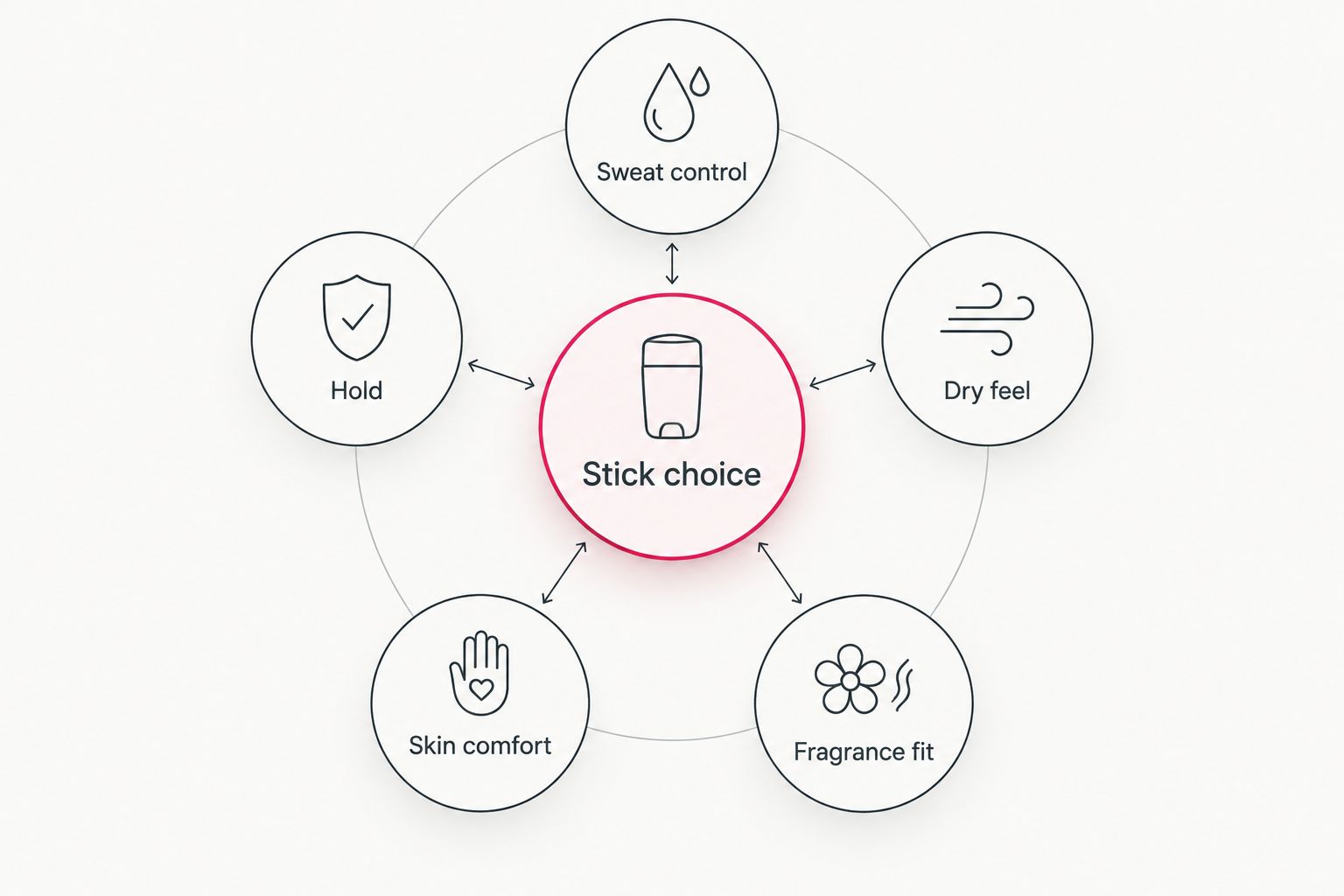
Use these criteria before choosing a product. They keep a 2026 shopping decision focused on what the label actually supports rather than the biggest promise on the package.
- Sweat control: Look for an antiperspirant active ingredient. A deodorant-only label does not establish wetness protection.
- Hold: Judge whether wetness returns during your usual activities when you follow the application directions.
- Dry feel: Separate sweat breakthrough from a product coating that feels tacky, waxy, or heavy.
- Skin comfort: Check warnings and stop using a product that causes irritation. Strength does not excuse discomfort.
- Fragrance fit: Choose a scent you want to wear, or look for fragrance-free labeling if avoiding added fragrance is your priority.
- Routine fit: Match the application instructions to a routine you can maintain, rather than assuming every stick works the same way.
An ingredient list also lets you make specific exclusions. Duradry describes its antiperspirants and deodorants as made without talc, silicone, BHT, PPGs, PEGs, and polyethylene. That is a defined ingredient preference, not a promise that every person will tolerate every formula.
Antiperspirant sticks at a glance
This is a buying-fit ranking, not a measured wear-time leaderboard. The named product is a clinical-strength option; the other entries are label-defined categories that help you choose the right kind of stick.
| Ranked option | Best for | Standout feature | Key limitation |
|---|---|---|---|
| Clinical Sweat Control Stick | Shoppers prioritizing clinical-strength protection | Clinical sweat protection with thoughtfully selected ingredients | Clinical positioning does not establish an exact wear time or residue-free finish |
| Fragrance-free antiperspirant stick | Shoppers avoiding added fragrance | Antiperspirant function without an added-fragrance preference | Fragrance-free does not mean irritation-free |
| Standard antiperspirant stick | A straightforward daily sweat-control routine | A familiar stick format with an antiperspirant active | Protection and finish depend on the individual formula |
| Deodorant-only stick | Odor management when wetness is not the concern | Targets odor rather than sweat reduction | Not an antiperspirant; skip it for dryness |
The categories overlap: a clinical-strength stick can also be fragrance-free. Pick your essential feature first, then check the individual product against the remaining criteria.
1. Clinical Sweat Control Stick: best for clinical-strength protection
Duradry Clinical Sweat Control Stick is the best fit here for shoppers seeking clinical-strength sweat protection with thoughtful ingredient exclusions. Its stated purpose is sweat control, so it belongs in an antiperspirant shortlist rather than an odor-only shortlist.
That distinction matters when your main frustration is damp underarms, not just scent. The product description establishes clinical protection and an ingredient-focused approach; it does not establish a universal dryness result or a precise number of hours of hold.
Clinical Sweat Control Stick pros:
- Offers clinical sweat protection, according to its product description.
- Uses the stick format for direct application.
- Aligns with the brand's stated ingredient exclusions.
- Addresses a sweat-control need rather than relying on fragrance alone.
Clinical Sweat Control Stick cons:
- Clinical-strength positioning does not guarantee the same result for every wearer.
- Sweat-control claims do not establish an invisible or non-sticky finish.
- A stick format alone does not establish suitability for every body area.
Best for: You want clinical-strength underarm protection and care about specific ingredient exclusions.
For your 2026 shortlist, start here if those are your priorities. Check the current label for the active ingredient, directions, warnings, and fragrance details before deciding that it matches your skin and routine.
Verdict: Buy for clinical-strength sweat protection; do not assume a specific wear time or finish.
2. Fragrance-free antiperspirant stick: best for avoiding added fragrance
A fragrance-free antiperspirant stick suits you when you want sweat reduction without choosing an added scent. This is a label-based category, not a single formula: the antiperspirant active and the rest of the ingredient list still matter.
Avoid treating fragrance-free as another word for gentle. Removing added fragrance addresses one preference, but it does not remove every possible cause of irritation. You still need a formula your skin tolerates.
Fragrance-free antiperspirant stick pros:
- Prioritizes avoiding added fragrance.
- Keeps antiperspirant function separate from scent preference.
- Gives fragrance-conscious shoppers a clear label feature to screen for.
Fragrance-free antiperspirant stick cons:
- Does not guarantee comfort on sensitive skin.
- Does not establish stronger hold than a scented antiperspirant.
- Requires checking the label rather than relying only on the product name.
Best for: You do not want an added fragrance in your sweat-control routine.
In 2026, read fragrance-free and unscented claims carefully. Unscented products can contain ingredients used to mask odor, so inspect the ingredient list if fragrance avoidance is your reason for choosing the product.
Verdict: Buy when avoiding added fragrance is your deciding factor.
3. Standard antiperspirant stick: best for a straightforward daily routine
A standard antiperspirant stick is a practical category to consider when you want a familiar application format without making clinical-strength positioning your first requirement. Confirm that the label identifies it as an antiperspirant, not simply a deodorant.
There is no single standard-stick formula. Active ingredients, fragrance, base ingredients, and directions vary, so this category cannot receive one honest rating for hold or dryness. Evaluate the actual product instead of assuming all everyday sticks perform alike.
Standard antiperspirant stick pros:
- Provides a straightforward format for localized application.
- Lets you choose around fragrance and ingredient preferences.
- Offers antiperspirant function when confirmed on the label.
Standard antiperspirant stick cons:
- The category does not establish clinical-strength protection.
- Texture and clothing transfer depend on the formula and application.
- Repeatedly applying more does not replace following the directions.
Best for: Your priority is a simple sweat-control routine, and clinical-strength positioning is not essential.
Give the product a fair assessment under its labeled instructions. If wetness remains your main complaint, reconsider the formula rather than switching between scents with the same expectations.
Verdict: Buy for a straightforward routine; reassess if it does not meet your wetness needs.
4. Deodorant-only stick: best for odor, not dryness
A deodorant-only stick belongs in this comparison because it is easy to confuse odor protection with sweat protection. Its purpose is managing odor; without antiperspirant function, it is not the right category for reducing wetness.
This is not a criticism of deodorant. It is a different job. If you are comfortable with normal perspiration and mainly want odor control, a deodorant-only stick can match that goal.
Deodorant-only stick pros:
- Targets odor when that is your actual concern.
- Offers a stick format without requiring antiperspirant function.
- Lets you separate scent preferences from a sweat-reduction decision.
Deodorant-only stick cons:
- Does not provide antiperspirant sweat reduction.
- A fresh scent does not mean your underarms are dry.
- Aluminum-free deodorant positioning does not establish equivalent wetness protection.
Best for: You want odor management and are not seeking to reduce sweating.
If dry underarms are your goal, check the label before purchasing. The word deodorant on its own is not enough; some products combine deodorant and antiperspirant functions, while others do not.
Verdict: Skip for dryness; buy only when odor control is the goal.
How to judge hold and dryness without confusing them
For a useful 2026 comparison, evaluate one formula at a time under its directions. Changing the product, application amount, and timing together makes it harder to identify what actually helped.
Hold: watch for returning wetness
Hold means how well sweat control meets your needs during your normal routine. Notice when dampness appears and what you were doing, rather than using fragrance persistence as a stand-in for protection.
Keep the context comparable. An office day and a strenuous workout make different demands; a result from one does not automatically describe the other. Avoid assigning a precise wear-time claim based on an isolated experience.
Dryness: separate moisture from coating
Dryness includes both reduced wetness and the feel of the product on your skin. A waxy coating is not necessarily sweat breakthrough, and a smooth finish does not prove that sweating has decreased.
Check your skin before adding more product. If the problem is residue, another layer does not address it. Follow the labeled application amount and assess the formula's finish separately from its sweat-control performance.
Comfort: treat irritation as a reason to stop
Burning, itching, or a rash is not evidence that an antiperspirant is working harder. Stop using an irritating product and follow its warnings; seek medical advice when symptoms persist or are concerning.
Avoid applying antiperspirant to broken or irritated skin. If shaving leaves your skin tender, use the product according to its warnings rather than pushing through discomfort for the sake of dryness.
How to apply an antiperspirant stick for a fair result
Read the label first. Application timing, permitted body areas, and warnings belong to the individual formula. Do not borrow instructions from another product just because both come in stick packaging.
The American Academy of Dermatology's guidance on excessive sweating recommends applying antiperspirant to dry skin before bed. Use that general guidance alongside your product's directions, not as permission to ignore them.
A simple assessment routine keeps the decision clear:
- Dry skin: Start with the skin condition specified by the product directions.
- Label directions: Follow the stated amount, timing, and application area.
- Normal routine: Evaluate protection during activities that reflect your actual needs.
- Skin comfort: Stop if irritation develops rather than layering on more.
Underarm application directions do not automatically extend to your face, intimate areas, hands, or feet. If sweating elsewhere is your concern, choose guidance and products intended for that area instead of assuming your stick is suitable everywhere.
How we ranked
The ranking prioritizes the stated purpose of each option: clinical-strength protection, fragrance avoidance, straightforward daily use, or odor management. Sweat-control function comes first; fragrance, skin comfort, and finish refine the choice.
This 2026 guide does not assign measured hold times or dryness scores. Duradry antiperspirant stick selection leads for a clinical-strength preference, not because a head-to-head wear test establishes it as the driest formula.
Which antiperspirant stick should you choose?
Choose Duradry Clinical Sweat Control Stick if clinical-strength sweat protection and the brand's stated ingredient exclusions match your priorities. Choose a fragrance-free antiperspirant when avoiding added fragrance is non-negotiable, or a standard antiperspirant when you want a straightforward routine.
Do not choose a deodorant-only stick to solve wetness. That mismatch is more important than scent, packaging, or the strength of an odor-protection claim.
If excessive sweating disrupts daily life despite appropriate product use, speak with a healthcare professional. Sudden or unexplained changes in sweating deserve medical attention rather than another product swap.
FAQ
What's the best antiperspirant stick for clinical-strength protection?
Duradry Clinical Sweat Control Stick is the best fit in this guide for shoppers prioritizing clinical-strength sweat protection and the brand's stated ingredient exclusions. That recommendation reflects product fit, not a measured comparison of wear times.
Is an antiperspirant stick better than a deodorant stick for wetness?
An antiperspirant stick is the appropriate choice for reducing wetness. A deodorant-only stick targets odor, although some products combine both functions.
Does clinical strength mean an antiperspirant will feel completely dry?
Clinical-strength positioning does not establish a completely dry or residue-free finish. Sweat reduction and the feel of the product base are separate considerations.
Should I apply an antiperspirant stick at night?
Follow your product's directions for application timing. The American Academy of Dermatology recommends applying antiperspirant to dry skin before bed in its guidance on excessive sweating.
Is a fragrance-free antiperspirant stick better for sensitive skin?
Fragrance-free labeling helps you avoid added fragrance, but it does not guarantee that a formula will suit sensitive skin. Check the full ingredient list and stop using a product that irritates your skin.
Can I use my underarm antiperspirant stick everywhere I sweat?
Use an antiperspirant stick only on the body areas permitted by its label. Underarm directions do not automatically establish suitability for hands, feet, the face, or intimate areas.
How can I tell whether a stick leaves residue or isn't controlling sweat?
Assess product coating separately from returning wetness. Follow the labeled application amount, then notice whether the problem is a waxy feel, visible transfer, or actual dampness.
One last thing
A stronger fragrance is not stronger sweat protection. Before replacing a disappointing stick, identify whether the failure was odor, wetness, residue, or irritation. That single distinction gives your next purchase a clear job to do.

