

Warehouse workers’ antiperspirant care is a routine that reduces perspiration in treated areas with the aim of making physical shifts more comfortable. The best starting point is an underarm antiperspirant applied to clean, dry skin—not extra deodorant applied after your shirt is already wet.
- Choose antiperspirant for warehouse workers when wetness—not just odor—is the concern.
- Duradry Clinical Sweat Control Stick is best for workers starting a daily underarm sweat and odor routine.
- Add nighttime underarm care only when your daily routine needs more support.
- Use body antiperspirant wipes only on permitted areas; underarm gel is not a hand or foot treatment.
- Sweat control supports comfort; it does not replace workplace heat precautions.
Why antiperspirant matters for warehouse workers
Picking, packing, loading, and moving between work areas make application timing a practical concern. You need a routine you can complete away from the warehouse floor, rather than a plan that depends on repeatedly finding a private place to reapply.
Wetness and odor also require different solutions. Antiperspirant reduces perspiration in the treated area; deodorant controls odor. If your current product smells pleasant but leaves your underarms wet, check whether its label actually says antiperspirant. The guide to using antiperspirant and deodorant together explains that distinction.
Duradry Clinical Sweat Control Stick is best for warehouse workers who want daily underarm sweat and odor protection in one step. Its limitation matters: it is an underarm product, not protection for every sweaty body area or a guarantee of complete dryness throughout a shift.
Build a routine around your shift
1. Identify where wetness actually interrupts your work
Start without buying anything. Notice whether the main problem is damp underarms, sweaty feet inside work shoes, odor after moving freight, or several separate concerns.
Be specific about when it happens. Wetness during heavy loading is a different situation from sweating while resting in a cool room. You do not need to diagnose yourself, but that distinction helps you choose between an ordinary personal-care adjustment and a medical conversation.
Keep the goal practical: less disruptive wetness in a defined area. Trying to eliminate all sweating during physical work is not a useful target.
- Check whether your existing product says antiperspirant, deodorant, or both.
- Note the body area you want to treat before choosing a format.
- Separate fresh sweat from odor remaining in work clothing.
- Record whether sweating also happens away from physical work.
2. Prepare clean, completely dry skin
Use your usual cleanser to remove sweat and product buildup, then dry the treatment area. A branded wash is not a prerequisite for antiperspirant use.
The important distinction is between cleansing and prevention. Washing removes material already on your skin; it does not prevent the next round of perspiration. Likewise, adding leave-on product over actively sweaty skin is not a substitute for following its application directions.
If you shower after work, leave enough separation before any nighttime gel application to meet that product’s instructions. The gel should not be applied immediately after bathing, even when you have towel-dried.
- Clean away sweat and residue before your planned application.
- Let the treatment area become completely dry.
- Check for broken, irritated, or recently shaved skin.
- Follow each product’s restrictions rather than copying another product’s routine.
3. Start with daily underarm protection
Before adding more products, check the timing and amount directed on your current antiperspirant. Consistent, correct use is a better first adjustment than automatically applying more.
For a straightforward daily option, Clinical Sweat Control Stick combines underarm antiperspirant and deodorant functions. Its directions specify 2–4 swipes per underarm on clean, dry skin. Use the current package label if your instructions differ.
The stick fits workers who want one daily underarm step. It contains fragrance, so it is not the right choice for someone specifically seeking a fragrance-free product. Clinical strength also does not mean irritation is impossible or that repeated applications during a shift improve results.
- Apply only to clean, dry underarms as directed.
- Use the labeled amount instead of repeatedly coating the same area.
- Give the application time to settle before putting on your work shirt.
- Stop use if rash or irritation occurs.
4. Add nighttime support for heavier underarm sweating
First check whether your daily product is an antiperspirant and whether you have followed its directions consistently. If you still need more underarm support, an overnight format provides a different application schedule—not a reason to stack products together.
Duradry Intensive Sweat Minimizing Gel is a nighttime underarm antiperspirant. Apply a pea-sized amount per underarm at bedtime to completely dry skin, following the current label. Wash it off the next morning, dry your underarms, and then apply your daytime product.
The gel is applied at bedtime to help reduce daytime underarm sweating; it is not designed to treat night sweats. For rotating or overnight shifts, do not assume clock time overrides the directions. Ask the manufacturer or a healthcare professional how to fit the labeled schedule around your sleep pattern.
The gel adds preparation and a wash-off step. It is not suitable for broken, irritated, or recently shaved skin, and its directions restrict use to underarms. Follow the label’s initial and maintenance schedules rather than choosing your own frequency.
- Keep gel application separate from your daily stick application.
- Do not apply immediately after bathing or to damp underarms.
- Wash the gel off as directed before applying daytime protection.
- Ask a doctor before antiperspirant use if you have kidney disease.
- Stop if rash or irritation develops; do not increase the amount.
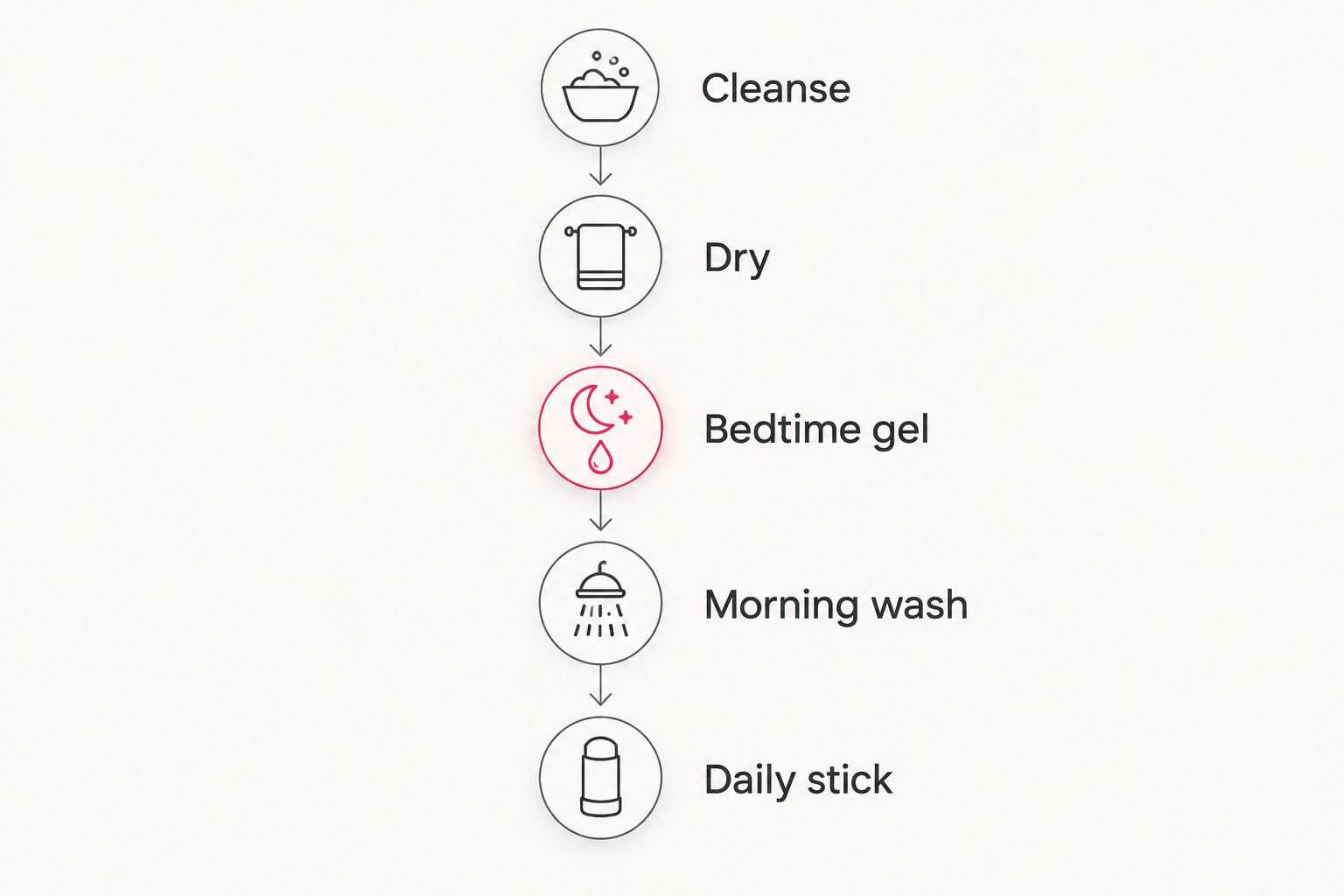
The underarm sequence is Cleanse, Dry, Bedtime gel, Morning wash, Daily stick. These are separate stages, not layers applied together.
5. Match body sweat care to the permitted area
Start with ordinary care appropriate to the area: wash and dry your skin, change damp socks when practical, and follow workplace requirements for footwear and gloves. Do not remove required protective equipment to make a personal-care routine more comfortable.
For targeted body sweat, Sweat Control Body Wipes are antiperspirant wipes, not cleansing cloths. The product’s named application areas include hands, feet, chest, back, thighs, and underarms, subject to current package directions.
Each pack contains 30 unscented wipes. The portable format is convenient, but portability does not establish immediate complete protection when applied to actively sweaty skin. Follow the package’s bedtime, drying, wash-off, and any permitted daytime-use instructions.
For odor without a need for sweat reduction, Duradry Deodorant Body Spray serves a different purpose. It helps control body odor; it does not replace an antiperspirant when your goal is less wetness.
- Choose body antiperspirant only for areas permitted by its label.
- Keep underarm gel off your hands and feet.
- Avoid the face, eyes, and mucous membranes.
- Let treated skin dry as directed before dressing or using equipment.
- Do not treat antiperspirant wipes as a substitute for handwashing.
6. Review comfort without escalating the routine
Check your routine outside work, when you have time to notice skin discomfort and follow the instructions. Keep the product, body area, application timing, and skin preparation consistent before deciding what needs changing.
Look at wetness, odor, and irritation separately. Less odor with unchanged dampness means something different from reduced wetness accompanied by a rash. Neither situation calls for automatically doubling the amount.
A work-bag refresh can still be simple: a clean shirt, spare socks, and access to washing when available. That is different from making a stronger antiperspirant application during every break.
- Compare comfort during similar tasks rather than expecting identical shifts.
- Check application technique before adding another sweat-control product.
- Keep a spare clothing layer when practical and permitted.
- Stop products that cause rash or irritation.
- Seek professional advice for persistent, disruptive, or suddenly changed sweating.
Compare formats by the job they do
Choose the smallest routine that addresses your concern. These are different tools, not an independent ranking or a requirement to buy the full range.
- Daily antiperspirant stick — best for routine underarm wetness and odor. One familiar format addresses both concerns. The limitation is its underarm-only use and, for the stick discussed here, added fragrance.
- Nighttime underarm gel — best for heavier underarm sweating needing an additional step. It separates intensive sweat care from your workday. The tradeoff is stricter preparation, skin restrictions, and morning wash-off.
- Body antiperspirant wipes — best for sweat on permitted body areas beyond the underarms. The format is portable and targeted. The tradeoff is disposable use and a schedule that still requires planning.
- Body deodorant spray — best for odor care without a sweat-reduction goal. An unscented format avoids adding a competing fragrance. Its limitation is straightforward: odor protection does not establish reduced perspiration.
- Body cleanser — best for removing sweat and buildup after work. It provides a clean starting point. A rinse-off wash does not prevent future sweating.
Do not buy an additional format unless it solves a different problem or fills a clear gap in your routine. A stick alone is a reasonable starting point for daily underarm care.
Common mistakes warehouse workers make
Treating every break as an application window
A break after loading or picking is not automatically the right time for more antiperspirant. If skin is actively sweaty, follow the product’s preparation instructions instead of applying another layer and expecting an immediate reset.
Using underarm gel inside work gloves or boots
The gel’s underarm directions do not extend to hands or feet. Choose a product labeled for the intended area, and never rely on antiperspirant as proof that your grip or footing is safe.
Applying every product before leaving home
A nighttime gel, daily stick, and body wipes are not interchangeable layers. More products used together do not establish better protection and make irritation harder to troubleshoot.
Expecting personal care to solve workplace heat
Antiperspirant is not heat protection. Follow your workplace’s cooling, hydration, rest, and protective-equipment procedures. If you feel unwell in the heat, stop work and follow the workplace response plan rather than reaching for another application.
FAQ
What is the best antiperspirant for warehouse workers to start with?
A daily underarm antiperspirant is the clearest starting point when underarm wetness is your main concern. Duradry Clinical Sweat Control Stick combines sweat and odor protection; add another format only when your needs justify it.
Why am I still wet at work after using deodorant?
Deodorant controls odor but does not necessarily reduce perspiration. Check the label for an antiperspirant function before changing the amount or adding more fragrance.
Should I apply antiperspirant before my warehouse shift?
Follow the timing on your specific product rather than using your shift start as the universal rule. A daily stick and a bedtime gel have different application and wash-off directions.
Can I use nighttime gel if I work overnight?
Do not assume a nighttime gel’s schedule can be changed without checking its directions. Ask the manufacturer or a healthcare professional how the labeled bedtime and wash-off routine fits your sleep schedule.
Can I use underarm antiperspirant gel on sweaty hands or feet?
Intensive Sweat Minimizing Gel is for underarms only. For hands or feet, choose a product whose current label permits those areas, such as Sweat Control Body Wipes used according to their directions.
Will body wash stop me sweating during my shift?
Body wash removes sweat, odor, and buildup during cleansing; it does not prevent new perspiration. Choose an antiperspirant when sweat reduction is the goal.
When should I ask a doctor about sweating at work?
Seek medical advice when sweating is persistent and disruptive, starts suddenly, occurs during sleep, or accompanies other symptoms. Sweating during physical work alone does not establish hyperhidrosis.
Related guides
One last thing
Your work bag is not always the best place to improve your sweat routine. Before your next shift, read your current product’s function and application directions, then identify one change: correct the timing, prepare drier skin, or choose an antiperspirant instead of deodorant alone. Start there before adding anything else.

