

Instead of repacking loose toiletries before every flight, build a carry-on kit around sweat wipes for travel, then separate solid products from liquids and gels. Pre-moistened wipes can travel outside your TSA liquids bag; antiperspirant wipes reduce sweat, while cleansing wipes serve a different purpose.
- Duradry Sweat Control Body Wipes suit travelers seeking targeted sweat reduction, not just a cleansing refresh.
- Pack sweat wipes for travel outside the liquids bag; keep gels and liquids within TSA carry-on limits.
- Choose antiperspirant for wetness and deodorant for odor; neither replaces washing.
- Follow each product’s application directions instead of adding extra applications around every flight.
Why this matters
A travel sweat-care kit has two jobs: keep your routine usable and fit airport screening rules. Packing everything into one toiletry pouch does not automatically accomplish either.
The most useful distinction is between removing sweat already on your skin and reducing perspiration. A cleansing wipe helps with the first; an antiperspirant addresses the second. Duradry Sweat Control Body Wipes are best for travelers seeking targeted body sweat control rather than cleansing alone.
Start with the Sweat Control Body Wipes if body sweat reduction is your goal. They are antiperspirant wipes designed for body use, including underarms, hands, feet, chest, and back. Follow the current package directions for permitted areas, application, and frequency rather than treating them like ordinary refreshing wipes.
Before you start
- Gather your materials: your chosen sweat-care products, their current labels, a clear quart-sized resealable liquids bag, and a separate pouch or accessible bag pocket for wipes and solids.
- Check the whole itinerary: apply TSA rules to U.S. checkpoints and check the relevant airport authority for international departures or connections. Your return flight can involve different screening requirements.
- Catch the easy-to-miss problem: a nearly empty oversized gel container still exceeds the carry-on container limit. TSA uses container capacity, not how much product remains inside.
For a 2026 U.S. carry-on kit, TSA’s published liquids rule permits containers holding no more than 3.4 fluid ounces, or 100 milliliters, inside one clear quart-sized bag per passenger. Pre-moistened wipes and solid stick deodorants do not need that liquids bag. Screening officers retain the final decision about what passes through the checkpoint.
Product selection
Match the product to the problem
- Name the concern. Decide whether you need less wetness, odor protection, cleansing, or a combination. Think about your actual itinerary: a warm walk to the station, a presentation after landing, or exercise before an evening flight.
- Choose the relevant format. Use an antiperspirant for sweat reduction. Choose deodorant for odor protection and a cleansing product for washing away sweat and buildup. Do not make a deodorant or body wash do the job of an antiperspirant.
- Check the application area. Read the specific product’s directions. A body-use wipe and an underarm-only gel are not interchangeable just because both reduce perspiration.
Expected result: every item in your kit has a clear job and an appropriate application area. Remove duplicates that serve no purpose on this trip.
Understand the useful options and their limits
- Sweat Control Body Wipes — best for targeted body sweat control. Their wipe format separates them from bottled gel in your packing plan. The limitation: they are antiperspirants, not a substitute for cleansing, and body use still requires following the label’s area restrictions.
- Clinical Sweat Control Stick — best for daily underarm sweat and odor protection. A solid stick stays outside the TSA liquids bag. Its limitation is scope: an underarm routine does not address every body area where you notice sweat.
- Intensive Sweat Minimizing Gel — best for intensive overnight underarm sweat control. It fits a planned bedtime routine rather than an improvised airport refresh. Its limitation for carry-on packing is format: gel belongs in the liquids bag and must meet the container limit.
This is Duradry’s product-purpose guidance, not an independent product test. Choose by function first, then packing convenience. A format that clears security easily is only useful if it addresses the concern you actually have.
Carry-on organization
Separate the screening categories
- Read each container. Find its labeled capacity and identify whether the contents are solid, liquid, gel, cream, or aerosol. Do not classify a product solely by the word deodorant on the front.
- Build the liquids bag. Put permitted-size gels, creams, liquids, and sprays into the clear quart-sized bag. Include the rest of your liquid toiletries in that same allowance; sweat care does not receive a separate bag.
- Pack wipes and solid sticks separately. Keep pre-moistened wipes in their original packaging and close the package as directed. Put them somewhere accessible without squeezing them among loose items.
- Check any spray separately. Do not assume a spray has the same packing requirements as a solid stick. Check TSA guidance and your airline’s rules for the particular aerosol or liquid you intend to carry.
Expected result: you can identify everything subject to the liquids rule without opening every pouch. Your wipe package remains readable and accessible.
Use an organizer without confusing it with the liquids bag
A general toiletry organizer holds your routine together; the clear quart-sized bag serves the screening requirement. One does not automatically replace the other.
If you use a larger pouch, keep the compliant liquids bag easy to reach inside it. Follow checkpoint instructions about whether to remove it. Screening procedures vary, so accessibility is more useful than assuming every airport will handle your bag identically.
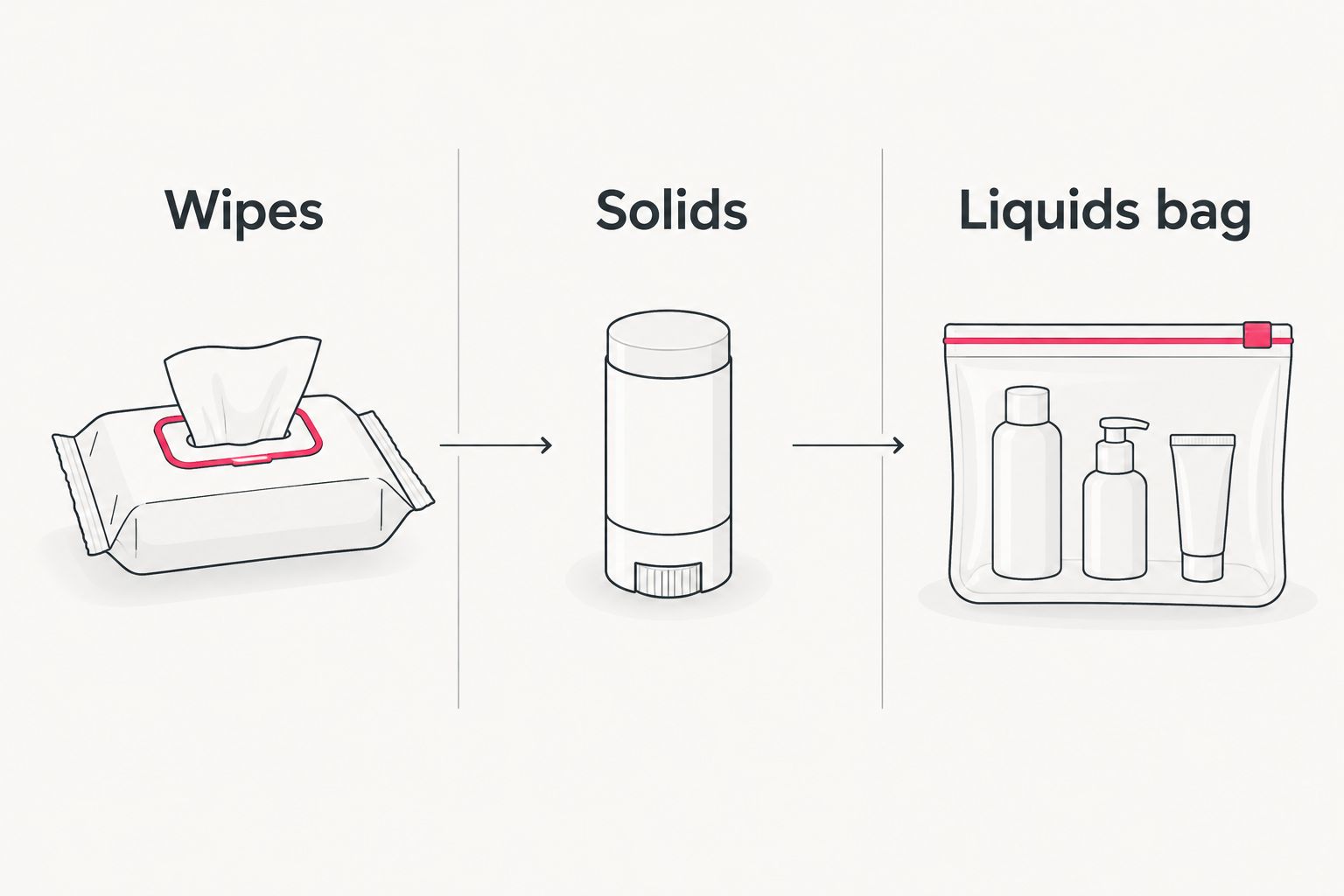
For your 2026 packing checklist, use these three categories: Wipes, Solids, and Liquids bag. Keep the categories simple enough to check while repacking at the hotel.
Application schedule
Keep treatment timing separate from flight timing
- Preserve your established routine. Follow the product’s stated timing and frequency. A boarding time is not a reason to add an extra antiperspirant application.
- Plan overnight products around bedtime. If you use Intensive Sweat Minimizing Gel, reserve it for its intended overnight underarm routine. Do not turn it into a general body treatment or an in-flight refresh.
- Prepare skin as directed. Follow the label’s instructions about clean, dry skin, shaving, and irritated areas. Do not layer products onto uncomfortable skin simply to finish your packing plan.
- Allow the application to finish before dressing. Follow any label directions about drying or absorption. Getting dressed immediately is not more important than using the product correctly.
Expected result: your trip preserves the product’s intended use instead of creating a new application schedule around airport queues.
For a long travel day, separate comfort measures from treatment. Changing a damp shirt or socks addresses wet clothing; it does not require another antiperspirant application. Washing addresses sweat and buildup without implying that perspiration is dirty or a personal failure.
Do not stack several antiperspirants on the same area simply because travel feels demanding. Start a new product before departure rather than making the airport bathroom your first-use setting. That gives you an ordinary setting in which to follow the directions and notice skin discomfort.
Departure check
Verify the kit before closing your bag
- Inspect the packaging. Close wipe packs and product caps as instructed. Replace damaged packaging rather than relying on another pouch to contain it.
- Read the gel and liquid capacities again. A container above 100 milliliters does not qualify merely because it is partly used. Choose a compliant container or leave that item out of the carry-on plan.
- Check access and labels. Keep application directions readable and place your wipes where you can retrieve them without unpacking your main luggage.
- Recheck the route. For a 2026 international itinerary, confirm the departure and transfer airport rules as well as TSA requirements. Review them again before the return journey.
Expected result: your kit is organized for screening and ordinary use, without depending on assumptions about container size or product purpose.
Avoid describing an individual product as TSA-approved. TSA publishes screening rules; packing a compliant kit does not create a product endorsement or guarantee admission through every checkpoint.
Second workflow: reset your kit after exercise
An exercise-to-airport transition needs a different sequence from a normal hotel departure. Cleanse first when needed, then return to your labeled sweat-care routine. Do not use an antiperspirant wipe as though it were a shower wipe.
- Change damp clothing. Keep worn exercise items separate from clean clothes and toiletries. This addresses what you are wearing without adding unnecessary treatment.
- Wash or cleanse as appropriate. If you use a cleansing wipe, recognize that its purpose differs from an antiperspirant wipe. Let the relevant product directions determine what happens next.
- Check whether an application is due. Follow the antiperspirant’s timing, frequency, and skin-preparation directions rather than automatically reapplying after every workout.
- Repack by category. Return wipes and solids to their accessible compartment and eligible liquids to the quart-sized bag.
This variant is best for travel days that include exercise or a warm commute. Its limitation is access: if you cannot prepare your skin as directed, changing clothes is a more practical immediate step than forcing an application into the schedule.
Troubleshooting
Your liquids bag will not close
Remove duplicate liquid products and reconsider which items you need during the trip. Do not solve the problem by moving a gel into an opaque pouch or carrying a second liquids bag. A solid format can simplify packing, but choose it only if it serves the same intended purpose.
Your wipe package has dried out
Do not assume a dried antiperspirant wipe delivers its intended application. Replace compromised wipes and follow package storage and closure instructions. Adding water does not establish that the product will work as directed.
You still notice wetness after using an odor product
Check whether the product is a deodorant or an antiperspirant. Odor control does not establish sweat reduction. If wetness is the concern, select an appropriate antiperspirant and follow its directions rather than repeatedly applying deodorant.
Your skin stings or becomes irritated
Stop applying the irritating product and follow its label instructions. Do not cover discomfort with another active product. Seek medical advice if symptoms persist or are significant; clean ingredient positioning does not mean a product cannot irritate skin.
Your flight is delayed and you want to reapply
Check the label, not the departure board. A delay does not reset application frequency. Use clothing changes and ordinary cleansing for immediate comfort when another antiperspirant application is not due.
Customize your workflow
Build around the situation, not the number of products. For a work trip, prioritize your established underarm routine and clothes you feel comfortable presenting in. For a warm-weather itinerary, consider the body areas where sweat actually bothers you and choose products labeled for those areas.
Duradry sweat care separates daily underarm protection, intensive overnight treatment, and targeted body sweat control. You do not need every format on every trip. The smallest useful kit is the one that preserves the routine you need without adding unrelated steps.
Keep a short packing note with product format, container capacity, application area, and application timing. Update it when you change products. That makes your next departure a check rather than a fresh research project.
FAQ
Can I bring sweat wipes for travel in my carry-on?
Yes. TSA permits pre-moistened wipes in carry-on bags, and they do not need to go inside the quart-sized liquids bag. Screening officers retain the final decision at the checkpoint.
Do antiperspirant wipes count as liquids at TSA?
Pre-moistened wipes do not need to be packed as liquid toiletries under TSA’s carry-on liquids rule. A separate bottle of liquid remains subject to the liquid-container requirements.
Are sweat wipes the same as deodorant wipes?
No. Antiperspirant wipes reduce perspiration, while deodorant wipes address odor and cleansing wipes remove material from the skin. Read the label rather than relying on the wipe format.
Can I use Duradry Sweat Control Body Wipes beyond my underarms?
Yes. Sweat Control Body Wipes are antiperspirant wipes designed for body use, including underarms, hands, feet, chest, and back. Follow the current package directions for all permitted areas and restrictions.
Does a solid antiperspirant stick need to go in my liquids bag?
No. A genuinely solid stick does not need the TSA liquids bag. Gel, cream, liquid, and spray formats require separate consideration under the applicable screening rules.
Can I pack a partly empty large antiperspirant gel?
Not under TSA’s standard carry-on liquids allowance if the container exceeds 3.4 fluid ounces or 100 milliliters. Container capacity determines compliance, not the amount remaining.
Should I apply extra antiperspirant before a long flight?
Follow the product’s labeled frequency rather than adding an application because the flight is long. Keep cleansing, changing damp clothing, and antiperspirant treatment as separate steps.
Related guides
- Sweat control wipes for excessive sweating
- Deodorant wipes for on-the-go odor control
- Shaving and your antiperspirant routine
One last thing
The easiest item to overlook is not a wipe—it is an oversized gel tube that is almost empty. Before your next departure, read the capacity on every liquid and gel container, then separate your wipes, solids, and liquids bag. That single check prevents a packing mistake without changing your sweat-care routine.

