

Yes, you can wear antiperspirant swimming at the beach or pool when you follow its label directions and apply it to clean, dry, unbroken skin. Antiperspirant helps reduce sweating in the treated area; it does not make your skin waterproof, prevent pool or ocean water from wetting you, or replace sunscreen. You do not need to add an extra application just because you plan to swim.
- You can wear antiperspirant swimming, but sweat control is not a waterproofing claim.
- Duradry Clinical Sweat Control Stick suits daily underarm sweat and odor protection, not sun protection.
- Apply antiperspirant to clean, dry skin according to its label—not to wet underarms between swims.
- Keep sunscreen and sweat care separate; swimming changes sunscreen reapplication needs.
Can you wear antiperspirant to the beach or pool?
Yes. Keep your usual, label-directed antiperspirant routine rather than creating a stronger routine for swimming. For everyday underarm protection, the Clinical Sweat Control Stick is an antiperspirant and deodorant: it addresses both wetness and odor.
A practical beach-day routine follows this order:
- Check your skin. Avoid applying antiperspirant to broken or irritated skin, and follow any shaving restrictions on the label.
- Apply to dry skin. Use the labeled amount on the permitted body area before your swim, rather than rubbing product onto damp skin at the water's edge.
- Handle sun protection separately. Apply sunscreen according to its own directions wherever skin is exposed.
- After swimming, reassess rather than automatically reapply. Rinse or shower as needed, dry your skin, and follow each product's instructions.
The useful distinction is between sweating and getting wet. Antiperspirant addresses perspiration from sweat glands; it cannot keep an underarm dry while that underarm is submerged in water.
Why this matters
A pool day involves several kinds of moisture: sweat on the walk there, water while swimming, and dampness trapped beneath a swimsuit afterward. Those do not all need the same solution.
If you notice wet underarms immediately after leaving the pool, that alone does not show your antiperspirant failed. Dry off before judging whether underarm sweating remains a concern. Adding more product to already wet skin is not a reliable way to answer that question.
You also need different expectations for different parts of the day. Sweat care can help with the commute, lunch outdoors, or getting dressed after a shower without promising dry skin in the water.
Does swimming wash antiperspirant off?
Swimming can remove material from the skin's surface, but antiperspirant is not simply a waterproof coating. Aluminum-based antiperspirant actives form temporary plugs within sweat ducts to reduce perspiration in the treated area.
That mechanism does not establish how much protection a particular formula retains after swimming. Water exposure, washing, and your product's directions matter; a clinical-strength label is not proof of tested swim resistance.
Avoid treating either of these assumptions as a rule:
- “One swim removes every bit of protection.” Surface residue and sweat-reducing action are not the same thing.
- “Clinical strength means waterproof.” Sweat-control positioning does not establish performance after immersion.
For Duradry sweat care, the practical recommendation is to follow the normal application schedule. Do not assume a swimming-specific protection duration or increase the dose to compensate for time in the water.
Should you apply antiperspirant before or after swimming?
Apply antiperspirant when the label directs and your skin is completely dry. That is more useful than choosing “before” or “after” without considering your existing routine.
Before swimming: keep your normal daily application
For a daily underarm stick, apply the directed amount to clean, dry underarms. The Clinical Sweat Control Stick directions specify 2–4 swipes per underarm.
There is no reason to double that amount for a beach trip. More product is not evidence of better performance in water, and a thicker layer does not create sunscreen protection.
Do not invent a universal waiting period between applying antiperspirant and entering the pool. Follow any drying or timing instructions on your particular package.
After swimming: dry your skin before deciding what comes next
If you shower after swimming, rinse thoroughly and dry your underarms before applying a leave-on product. Check the product's frequency instructions instead of assuming every shower requires another full application.
If your skin feels sore or looks irritated, skip another antiperspirant application. Do not try to cover discomfort with additional fragrance or a stronger sweat-control step.
The night before: maintain an established nighttime routine
If you already use a nighttime antiperspirant, swimming the next day is not a reason to move that application to the pool changing room. Keep the bedtime and morning wash-off steps specified by the label.
Nighttime application is a schedule for sweat control—not a treatment for sweating during sleep. Persistent night sweats need a different discussion from planning underarm protection for a swim.
Which underarm format fits a swim day?
Choose your format for your usual sweating needs, not because one format sounds more water-resistant. A stick and a nighttime gel have different jobs and instructions.
Daily stick: best for everyday underarm sweat and odor
Duradry Clinical Sweat Control Stick is best for people seeking daily underarm sweat and odor protection. Its familiar application format fits a morning routine before commuting, meeting friends, or heading to the beach.
Its limitation is equally specific: it is an underarm product, not a whole-body swimming treatment. Do not extend its use to the face, chest, or other areas because those areas also sweat, and do not assume it prevents white marks or swimsuit transfer.
Nighttime gel: best for heavier underarm sweating
The Intensive Sweat Minimizing Gel adds a bedtime step for heavier underarm sweating. It is applied to completely dry underarms and washed off the next morning, with the current label governing its schedule.
The tradeoff is a more deliberate routine. Do not apply it immediately after bathing or to broken, irritated, or recently shaved skin. It is not a poolside touch-up, and you should not layer it with other antiperspirants to try to create waterproof protection.


Why your beach-day routine varies
The right routine depends on your skin and the product you already use. These factors change the decision without requiring an entirely new collection of products:
- Your main concern. Underarm wetness calls for an antiperspirant; odor alone does not automatically call for stronger sweat reduction.
- Application timing. A daily stick and a bedtime gel are not interchangeable touch-ups.
- Skin dryness. Skin should be completely dry before antiperspirant application, even if you have just showered or towel-dried after swimming.
- Skin condition. Irritation, broken skin, and product-specific shaving restrictions take priority over your plans.
- The treated area. Follow the permitted application areas on the product in your hand rather than borrowing directions from another format.
- Your established schedule. A maintenance routine should follow the label; swimming does not automatically justify extra applications.
Is deodorant enough for a beach or pool day?
Deodorant is enough when your goal is odor control rather than sweat reduction. If you want less underarm wetness before or after swimming, choose a product labeled as an antiperspirant.
This distinction also matters when comparing natural deodorants for heavy sweating: “natural” describes positioning or ingredient choices, not proof that a product reduces perspiration. Look for the product's actual function and labeled directions rather than expecting an odor-care formula to perform an antiperspirant's job.
A fragrance preference is a separate decision again. A subtle scent or unscented format can suit your routine, but fragrance intensity does not tell you how much sweat reduction to expect.
Cleansing has another role. Washing removes sweat, odor, and buildup already on your skin; it does not prevent new perspiration after you leave the shower.
How do sunscreen and antiperspirant fit together?
Sunscreen protects against ultraviolet exposure; antiperspirant reduces sweat in its permitted treatment area. Neither replaces the other, and you should not mix the formulas together to simplify application.
The American Academy of Dermatology recommends broad-spectrum, water-resistant sunscreen with SPF 30 or higher. Sunscreen generally needs reapplication at least every 2 hours outdoors and after swimming or sweating, according to its label.
The FDA permits water-resistance claims of 40 or 80 minutes for sunscreens that meet the relevant testing requirements. Those intervals belong to sunscreen labeling—not to antiperspirant performance—and towel drying also matters for sunscreen reapplication.
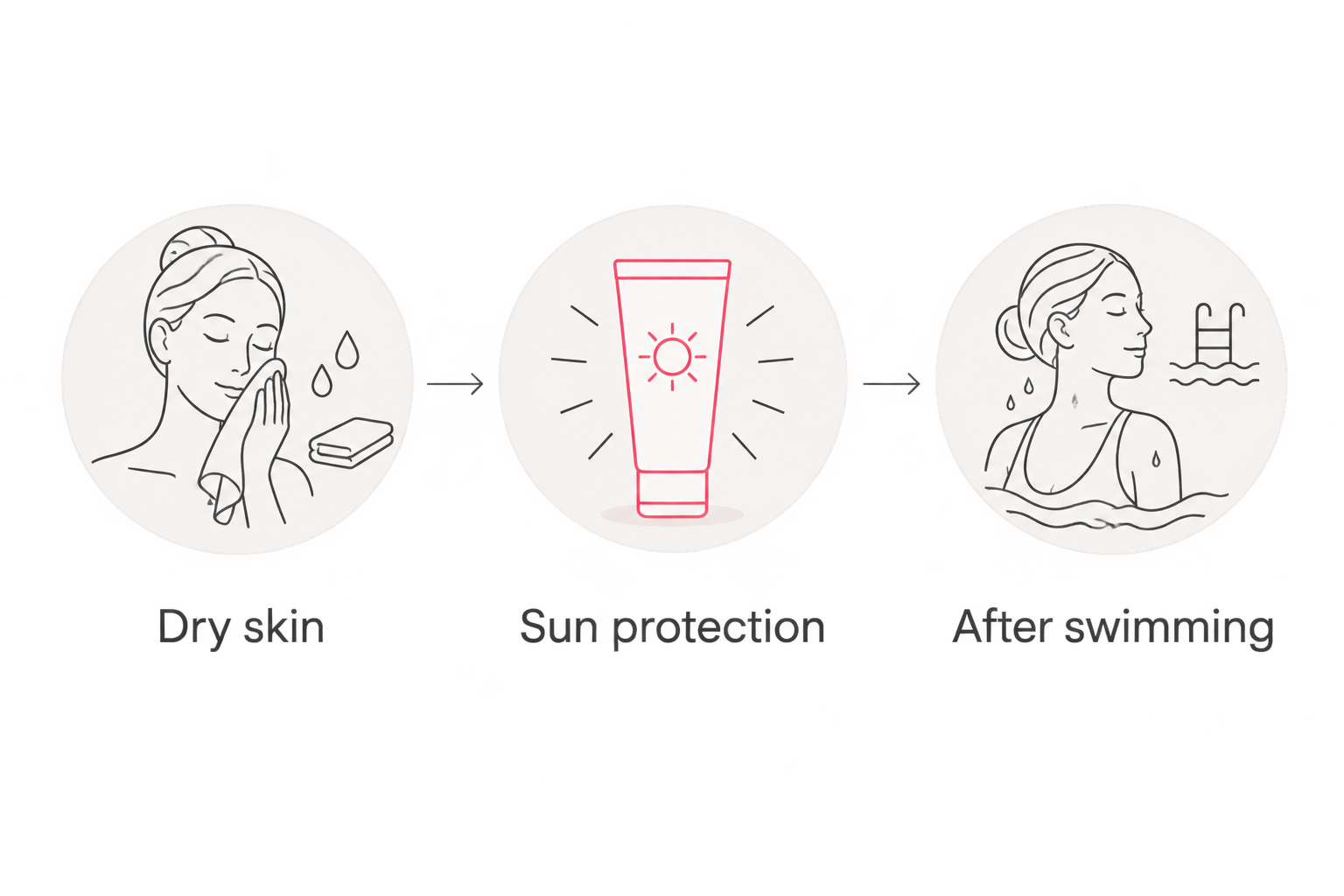
Keep the process clear:
- Dry skin: apply antiperspirant only as its directions permit.
- Sun protection: follow sunscreen directions for exposed skin, including exposed underarm skin.
- After swimming: follow sunscreen reapplication instructions and reassess your skin before applying more sweat care.
Do not use reduced sweating as a sign that you can stay in the sun longer. Shade, clothing, and your sunscreen routine remain important whether your underarms feel dry or not.
What if your underarms sting after swimming?
Stop applying antiperspirant if rash or irritation occurs. Rinse the area gently and avoid adding more leave-on products to sore skin.
Review the circumstances before your next application. Recently shaved skin, existing irritation, and applying a product contrary to its bathing restrictions are reasons to revisit the directions—not reasons to increase the amount.
You do not need to decide for yourself whether the antiperspirant, swimming, or something else caused the reaction. Persistent or severe symptoms warrant professional advice. Antiperspirant labels also direct people with kidney disease to ask a doctor before use.
FAQ
Can you wear antiperspirant swimming in a chlorinated pool?
Yes, you can wear antiperspirant while swimming in a chlorinated pool when you follow its label. Do not interpret that as a guarantee of water resistance or apply more than directed.
Can I wear antiperspirant in the ocean?
Yes, you can keep your label-directed antiperspirant routine when swimming in the ocean. Apply it to clean, dry, unbroken skin, and handle sunscreen separately.
Should I reapply antiperspirant after every swim?
No, swimming does not automatically require another antiperspirant application. Follow the product's frequency instructions and apply only when your skin is clean, dry, and not irritated.
Does antiperspirant protect my underarms from sunburn?
No, antiperspirant does not provide sunscreen protection. Use sunscreen according to its directions on exposed skin, including exposed underarm skin.
Can I apply nighttime antiperspirant gel right after my pool shower?
Do not apply Intensive Sweat Minimizing Gel immediately after bathing. Its directions call for bedtime application to completely dry underarms, followed by washing it off the next morning.
Will antiperspirant keep me dry while I am in the pool?
No, antiperspirant cannot stop pool water from wetting your skin. Its purpose is to reduce perspiration in the treated area, not to create a waterproof barrier.
One last thing
Judge your antiperspirant after you have dried off, not while your swimsuit and skin are still wet. Water from swimming is not a useful measure of sweat control.
For your next beach or pool day, keep the antiperspirant routine that fits your usual needs and check your sunscreen's water-resistance and reapplication directions before you leave.

