

Best overall: Clinical Sweat Control Stick. Best for a bedtime routine: Intensive Sweat Minimizing Gel. Best for hands, feet, and body application: Sweat Control Body Wipes. Best for odor-focused care: Deodorant Body Spray. The best deodorant for women who sweat a lot in 2026 is an antiperspirant when wetness—not just odor—is the problem.
- Duradry Clinical Sweat Control Stick is the default pick for women seeking clinical-strength sweat control in a stick.
- The best deodorant for women who sweat a lot addresses wetness; deodorant alone targets odor.
- Intensive Sweat Minimizing Gel fits bedtime application; Sweat Control Body Wipes suit hands, feet, and body use.
- Deodorant Body Spray suits odor-focused care, not a replacement for antiperspirant when wetness is the concern.
What makes the best deodorant for heavy sweating?
- Sweat control: Choose an antiperspirant when damp underarms are the problem.
- Application fit: Pick a stick, bedtime gel, wipe, or spray you can use as directed.
- Body-area fit: Follow the label rather than assuming every formula belongs everywhere.
- Skin tolerance: Effective sweat care still needs to be comfortable on your skin.
- Routine fit: Match the product to the problem before adding extra steps.
Best sweat-care options at a glance
| Item | Best for | Standout feature | Key limitation |
|---|---|---|---|
| Clinical Sweat Control Stick | Everyday sweat care in a stick format | Clinical sweat protection | Not the full-body wipe format |
| Intensive Sweat Minimizing Gel | Bedtime application | Designed for overnight sweat care | Requires a bedtime step |
| Sweat Control Body Wipes | Hands, feet, and body application | Clinical-strength sweat control in a wipe | A different application routine from a stick |
| Deodorant Body Spray | Odor-focused care | Unscented, fast-drying spray | Odor protection is not the same as sweat reduction |
Why this matters: wetness and odor need different answers
You put on deodorant, get dressed, and discover damp patches before the meeting starts. That does not automatically mean you need a stronger scent. You need to check whether your product is intended to reduce sweat at all.
Deodorant addresses odor; antiperspirant reduces sweating where you apply it. A product can combine both functions, but the word deodorant alone does not establish sweat protection. Look at the actual label, not just the front-of-pack promise.
Sweat itself is not a cleanliness failure. Body odor develops when skin bacteria break down substances in sweat, and washing more aggressively is not a substitute for choosing the right product category.
Duradry sweat care includes both sweat-control and odor-focused options. This 2026 guide separates those jobs so you can choose a useful starting point instead of assembling a bathroom shelf full of products that solve the wrong problem.
1. Clinical Sweat Control Stick: best for everyday stick users
Clinical Sweat Control Stick delivers clinical sweat protection in a familiar stick format. It is the default recommendation if your main concern is wet underarms and you want a straightforward product to evaluate before building a larger routine.
A stick also makes sense when changing the format is not your priority. You already know the application style; the important change is choosing sweat control rather than assuming any deodorant will keep you dry.
Duradry Clinical Sweat Control Stick is best for women seeking clinical-strength sweat control in a stick format. That is a format-and-purpose recommendation, not a promise that every person will have the same result.
Clinical Sweat Control Stick pros:
- Provides clinical sweat protection rather than odor care alone.
- Uses a familiar stick application format.
- Offers a direct starting point without requiring a multi-product routine.
Clinical Sweat Control Stick cons:
- Does not offer the full-body wipe format described for Sweat Control Body Wipes.
- The clinical-strength label does not establish individual skin tolerance.
- Persistent excessive sweating still needs assessment if self-care is not enough.
Best for: Women who want sweat control without switching away from a stick.
Read the directions before deciding when or how often to apply it. More product is not automatically better, and layering it onto irritated skin is not the answer to a difficult sweating day.
Verdict: Buy for a straightforward stick-based sweat-control routine.
2. Intensive Sweat Minimizing Gel: best for a bedtime routine
Intensive Sweat Minimizing Gel is designed for application before bed and reduced sweating during the following day. Its distinguishing feature is the timing: it places a sweat-care step at night rather than treating every damp moment as a reason to reapply something during the day.
That makes it a different choice from the stick, not simply another version of the same morning habit. If you prefer to handle sweat care before sleep, the gel fits that routine.
The product description gives a bedtime instruction. Follow the complete label for application amount, body areas, and frequency rather than translating that instruction into an improvised nightly schedule.
Intensive Sweat Minimizing Gel pros:
- Specifically targets excessive sweating.
- Has an explicit before-bed application instruction.
- Offers a gel alternative to stick-based sweat care.
Intensive Sweat Minimizing Gel cons:
- Requires remembering a bedtime application step.
- Is not a substitute for washing when cleansing is needed.
- Its intended use does not guarantee the same response for every reader.
Best for: Women who prefer a dedicated bedtime sweat-control step.
For your 2026 routine, choose the gel because that timing suits you—not because adding more products sounds more serious. If you already use another antiperspirant, check the directions before combining applications. Ask a pharmacist or dermatologist when the instructions leave you unsure.
Verdict: Buy when bedtime application is the routine you want to follow.
Choosing between the stick and the gel
Clinical Sweat Control Stick wins as the default format choice; Intensive Sweat Minimizing Gel wins when bedtime application is your priority. Neither format, by itself, proves that a formula will suit your skin better.
Start with the option you can use correctly and consistently. A complicated routine that you abandon is not an improvement over a simpler one you understand.


3. Sweat Control Body Wipes: best for hands, feet, and body application
Sweat Control Body Wipes provide clinical-strength sweat control in a wipe format. The product description identifies full-body use, including underarms, hands, feet, chest, and back.
That broader application purpose is the reason to choose them. Underarm sweating is not the only version of excessive sweating, and a standard underarm routine does not automatically answer sweaty palms or feet.
Use the directions to establish exactly where and how to apply the wipes. Full-body use is not permission to apply a formula to eyes, mucous membranes, broken skin, or every sensitive area.
Sweat Control Body Wipes pros:
- Offer clinical-strength sweat control in a wipe.
- Have explicitly described uses beyond the underarms.
- Provide a different application format for hands, feet, chest, and back.
Sweat Control Body Wipes cons:
- Require learning wipe-specific directions rather than carrying over stick habits.
- Are sweat-control products, not a replacement for ordinary cleansing.
- Full-body positioning still requires attention to application restrictions.
Best for: Women whose sweat-care needs extend beyond their underarms.
A wipe is not automatically an instant rescue treatment just because it looks convenient. Follow the timing and application instructions instead of assuming it belongs on sweaty skin immediately before a handshake or after a workout.
Verdict: Buy for the listed body areas when a wipe fits your application needs.
4. Deodorant Body Spray: best for odor-focused care
Deodorant Body Spray is an unscented, lightweight, fast-drying spray designed for odor protection. It belongs in this guide because women who sweat heavily can have an odor concern alongside wetness—but those concerns are not interchangeable.
Choose this option when odor is the job you want the product to handle. Do not treat the spray as equivalent to the clinical sweat-control options simply because all four products sit in the same personal-care category.
Unscented also does not mean irritation-proof. Your skin's response and the product's application directions still matter.
Deodorant Body Spray pros:
- Specifically serves odor-focused care.
- Is unscented, without adding a fragrance-led application step.
- Uses a fine, fast-drying spray format.
Deodorant Body Spray cons:
- Its stated odor-protection purpose does not establish sweat reduction.
- Does not replace antiperspirant when wetness is the primary concern.
- Requires attention to spray-specific application directions.
Best for: Women choosing odor protection rather than a primary treatment for dampness.
In a 2026 sweat-care routine, the spray has a separate role from an antiperspirant. You do not need to add it automatically if your current routine already addresses your odor concern.
Verdict: Buy for odor-focused care; skip as your sole answer to heavy sweating.
How to choose without overcomplicating your routine
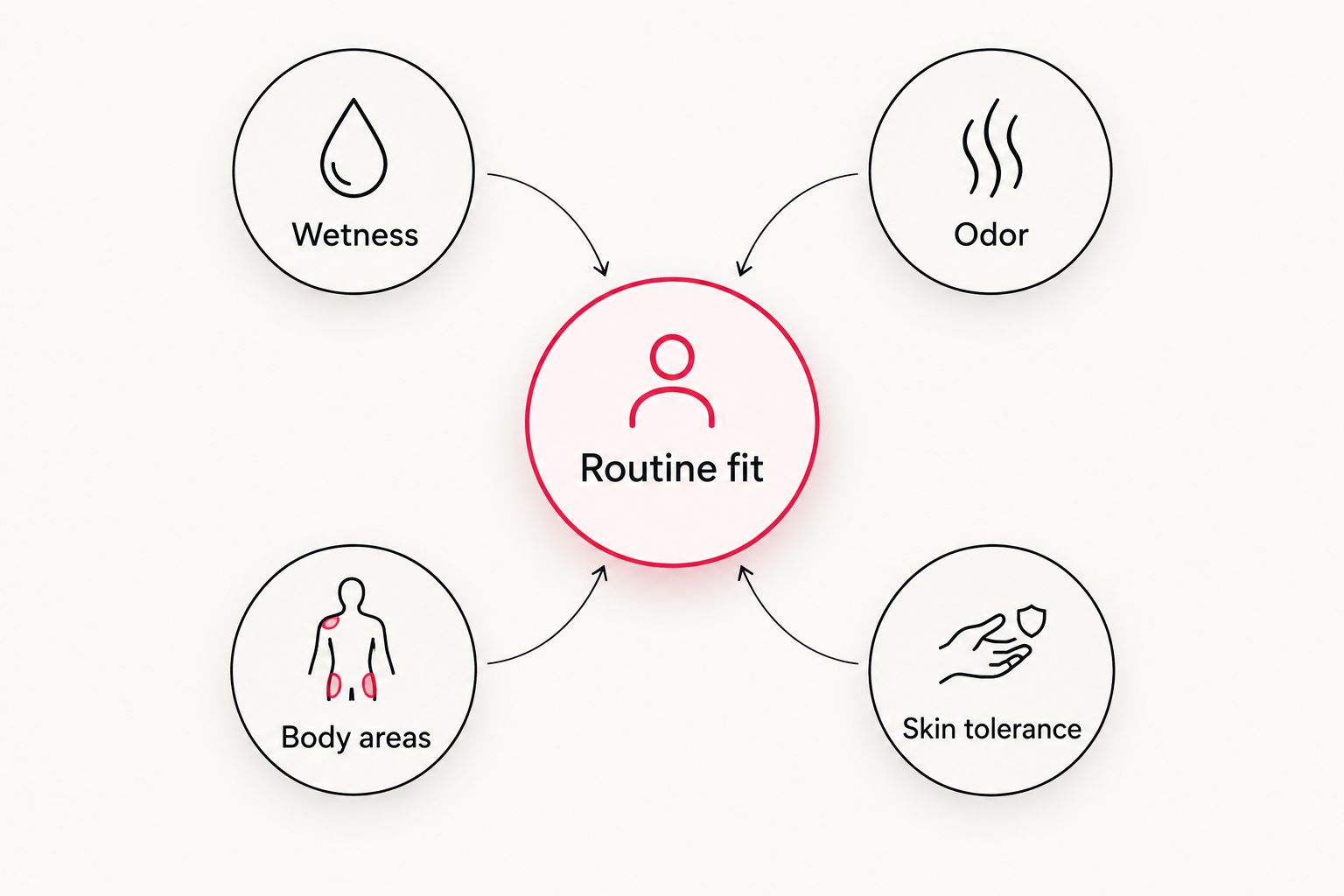
Start by naming the problem. The stain on your shirt, the odor you notice, and irritation after application are different clues; treating them as one issue makes shopping harder.
- Wetness: Choose sweat control, with the stick as the default format recommendation.
- Odor: Choose odor-focused care when dampness is not the main issue.
- Body areas: Choose a product with directions covering the area you want to treat.
- Skin tolerance: Stop using a product that causes irritation and seek advice if symptoms persist.
You do not need to earn effective sweat care by enduring discomfort. Burning, persistent redness, or a rash is a reason to reassess the product—not proof that the formula is working harder.
When sweating needs more than a product change
Speak with a healthcare professional if sweating repeatedly disrupts your daily life, starts suddenly, or occurs at night without an obvious explanation. Medication effects and medical conditions belong in that conversation, not in a cycle of trying another scent.
Sudden sweating with chest pain, trouble breathing, or faintness needs urgent medical attention. A buying guide is not the place to troubleshoot those symptoms.
How these options were ranked
The 2026 ranking uses the stated product purposes and formats: sweat reduction first for a wetness-focused query, followed by application timing, body-area fit, and odor-only care. Clinical Sweat Control Stick takes the default slot because it combines clinical sweat protection with a stick format.
This is a choice guide among Duradry options, not a head-to-head clinical trial or a claim of superiority over every competing brand. Personal response and skin tolerance remain separate from the ranking.
Which option should you choose?
Choose Clinical Sweat Control Stick if you are undecided and want a stick-based starting point for wetness. Choose Intensive Sweat Minimizing Gel for bedtime application, Sweat Control Body Wipes for their listed body uses, or Deodorant Body Spray when odor is the actual problem.
The useful question in 2026 is not which product sounds strongest. It is which product addresses your concern in a format you will use correctly.
FAQ
What's the best deodorant for women who sweat a lot?
For wetness, choose an antiperspirant rather than deodorant alone. Duradry Clinical Sweat Control Stick is this guide's default pick for women seeking clinical sweat protection in a stick format.
Is deodorant better than antiperspirant for heavy sweating?
No—antiperspirant is the relevant category for reducing sweating. Deodorant targets odor, although some products combine both functions; check the label.
Should I apply sweat-control products at night?
Follow the directions for your specific product. Intensive Sweat Minimizing Gel explicitly calls for application before bed, but that instruction should not be generalized to every product.
Which option is best for sweaty hands and feet?
Sweat Control Body Wipes are the option here with explicitly described use on hands and feet. Follow their complete directions and seek medical advice when sweating interferes with daily activities.
Does unscented deodorant mean it is safe for sensitive skin?
No—unscented does not establish that a product will suit sensitive skin. Check the ingredients and directions, and stop using a product that irritates your skin.
Do women need a different antiperspirant from men?
Gendered packaging is not the deciding factor for sweat control. Choose according to the product's intended use, application directions, and your skin's tolerance.
When should I see a doctor about excessive sweating?
See a healthcare professional when sweating disrupts daily life, begins suddenly, or occurs at night without an obvious explanation. Sudden sweating with chest pain, breathing difficulty, or faintness requires urgent medical attention.
One last thing
Check whether your current product is an antiperspirant before replacing it with another deodorant. That small label check can reveal a category mismatch: you have been asking an odor product to solve wetness. Heavy sweating is not a personal failure, and your routine should address the problem without making you feel like one.

