

Best overall: a foot-labeled roll-on or lotion antiperspirant. Best for touch-free application: a foot-labeled antiperspirant spray. Best for portable application: foot-labeled antiperspirant wipes. Best for persistent sweating despite correct use: clinician-directed treatment. This 2026 guide separates sweat reduction from odor control so you can compare Duradry and other sweat-care options without mistaking an underarm product for a foot treatment.
- The best antiperspirant for sweaty feet explicitly permits foot use and fits a routine you can follow.
- Choose a roll-on or lotion for controlled placement, a spray for touch-free application, or wipes for portability.
- Deodorant controls odor; antiperspirant reduces sweating. Foot odor and wet socks need different decisions.
- Duradry offers antiperspirants and deodorants; check each product’s application directions before considering it for feet.
- Persistent sweating, damaged skin, or a sudden change in symptoms calls for medical advice, not stronger experimentation.
Why this matters
Sweaty feet are not a hygiene failure. Feet produce sweat, and closed shoes create an environment where moisture can linger. A fragrant product can change how your feet smell without changing how wet your socks feel.
Choose for the problem you actually want to solve. If wetness is the issue, look for an antiperspirant. If odor is the issue, deodorant and washing serve different roles. If both bother you, build a routine that addresses both rather than expecting one label claim to do everything.
For your 2026 shopping shortlist, application-site directions matter more than packaging language. Terms such as clinical strength, whole body, and long lasting do not establish that a product belongs on your soles.
What makes the best antiperspirant for sweaty feet?
Use these criteria before choosing a format:
- Foot-use directions: The label should explicitly permit use on feet. Underarm directions do not automatically transfer to soles or between toes.
- Sweat-reducing function: Look for an antiperspirant active ingredient and sweat-reduction directions, not just fragrance or deodorizing claims.
- Controlled application: You should be able to apply the directed amount to the intended area without coating surrounding skin unnecessarily.
- Skin tolerance: Burning, redness, or itching is a reason to stop and reassess, not proof that a formula is working harder.
- Routine fit: Choose a format you can apply as directed. Portability and convenience matter only after suitability is established.
- A clear stopping point: Persistent symptoms or repeated irritation should lead to professional advice rather than repeated product layering.
Duradry sells clinical-strength antiperspirants, deodorants, sweat-minimizing gels, body washes, and wipes. Those categories serve different purposes; their names alone do not establish foot suitability. For Duradry antiperspirants, the product’s application directions—not its category name—decide whether foot use is appropriate.
Ingredient preferences belong in this decision, too. Check the ingredient list for known sensitivities and fragrance preferences, but do not treat a shorter list or a stronger scent as evidence of better sweat reduction.
Foot antiperspirants at a glance
These 4 options are ranked by application use case, not by a claimed difference in clinical effectiveness. Every over-the-counter recommendation below depends on explicit foot-use directions.
| Option | Best for | Standout feature | Key limitation |
|---|---|---|---|
| Foot-labeled roll-on or lotion antiperspirant | Controlled placement | Direct application to the intended area | Requires spreading or applicator contact; skin irritation remains possible |
| Foot-labeled antiperspirant spray | Touch-free application | Applies without rubbing the product on by hand | Overspray and inhalation precautions require attention |
| Foot-labeled antiperspirant wipes | Portable application | A wipe format that is easy to carry | A deodorizing or cleansing wipe is not necessarily an antiperspirant |
| Clinician-directed antiperspirant treatment | Persistent sweating after correct self-care | Treatment selection and instructions matched to symptoms | Requires professional assessment and careful adherence |
A spray does not automatically outperform a lotion. A wipe does not automatically provide weaker treatment. Compare the active ingredient, permitted application site, and instructions before treating format as a performance claim.
1. Foot-labeled roll-on or lotion: best for controlled placement
A roll-on or lotion antiperspirant lets you place the product directly where its label permits application. This makes it a practical default when you want deliberate placement rather than a mist.
The important feature is not the texture. It is the combination of an antiperspirant function and explicit foot-use instructions. A moisturizing foot lotion without an antiperspirant active belongs in a different category.
Roll-on or lotion pros:
- Direct application supports deliberate placement.
- No airborne mist to manage during application.
- Directions can specify the intended area and amount.
Roll-on or lotion cons:
- Application involves skin contact or spreading.
- Residue and feel depend on the individual formula.
- Antiperspirant ingredients can irritate skin, especially when used incorrectly.
Best for: You want a straightforward home routine and control over where the product goes.
Follow the label’s timing and drying instructions. Do not apply extra coats because your socks were wet earlier that day; increasing the amount is not a substitute for following the directions.
Verdict: Buy a foot-labeled roll-on or lotion as the default format when controlled placement is your priority.
2. Foot-labeled antiperspirant spray: best for touch-free application
An antiperspirant spray applies a sweat-reducing formula without requiring you to spread it by hand. It suits readers who prefer a touch-free format, provided the product specifically permits foot application.
Read beyond the word spray. A deodorant body spray, shoe freshener, and foot antiperspirant have different purposes. Instructions for spraying inside shoes do not establish that the same product is suitable for skin.
Antiperspirant spray pros:
- No hand-spreading step.
- A useful format when applicator contact is inconvenient.
- Foot-specific directions establish where and how to apply it.
Antiperspirant spray cons:
- Overspray can reach unintended surfaces or skin.
- Aerosol products require attention to ventilation and label warnings.
- Touch-free application does not establish better sweat reduction.
Best for: You prefer a mist to direct-contact application and can follow the spray’s safety instructions.
Use only as directed, including distance, location, and ventilation precautions. Do not spray into socks or shoes unless the product label specifically instructs you to do so.
Verdict: Buy a foot-labeled antiperspirant spray for touch-free application; skip sprays that promise freshness without sweat reduction.
3. Foot-labeled antiperspirant wipes: best for portable application
An antiperspirant wipe delivers its formula through a wipe rather than a bottle applicator. The format is useful when portability matters, but the wipe must both reduce sweating and permit foot use.
A cleansing wipe removes material from the skin. A deodorizing wipe addresses odor. Neither function proves that the wipe acts as an antiperspirant, even when the packaging mentions sweat.
Antiperspirant wipe pros:
- A portable format for following your routine away from home.
- No separate spreading tool is necessary.
- Product-specific instructions define the intended application area.
Antiperspirant wipe cons:
- Wipes create disposable waste.
- Cleansing and deodorizing claims can be mistaken for sweat reduction.
- Convenient packaging does not remove the need to prepare skin correctly.
Best for: You need a portable application format and can still meet the product’s skin-preparation requirements.
Do not assume a wipe is intended for repeated use throughout the day. Application frequency comes from its directions, not from how easily the packet fits in your bag.
Verdict: Buy foot-labeled antiperspirant wipes for portability; skip ordinary cleansing wipes as a substitute for sweat treatment.
4. Clinician-directed treatment: best for persistent foot sweating
When foot sweating continues despite correct antiperspirant use, a clinician can assess the symptoms and discuss treatment. Persistent excessive sweating can involve hyperhidrosis, but wet socks alone are not a diagnosis.
Clinician-directed care can include prescription antiperspirants or other treatments. The useful distinction is individualized assessment—not simply finding the strongest-sounding bottle in a 2026 roundup.
Clinician-directed treatment pros:
- Symptoms and possible contributing factors receive assessment.
- Application instructions can be tailored to the treatment selected.
- You can discuss alternatives when topical products fail or irritate your skin.
Clinician-directed treatment cons:
- Requires an appointment rather than an immediate shopping decision.
- Prescription antiperspirants can still cause irritation.
- Treatment requires adherence and follow-up when symptoms persist.
Best for: Sweating interferes with daily life, appropriate self-care has not helped, or your symptoms have changed.
The American Academy of Dermatology’s public hyperhidrosis guidance identifies antiperspirants and iontophoresis among treatment options. Iontophoresis is a treatment commonly used for excessive sweating of the hands and feet; it is not another deodorant format.
Verdict: Hold off on further product experimentation and seek assessment when persistent sweating defeats a correctly followed routine.
How to use your chosen antiperspirant
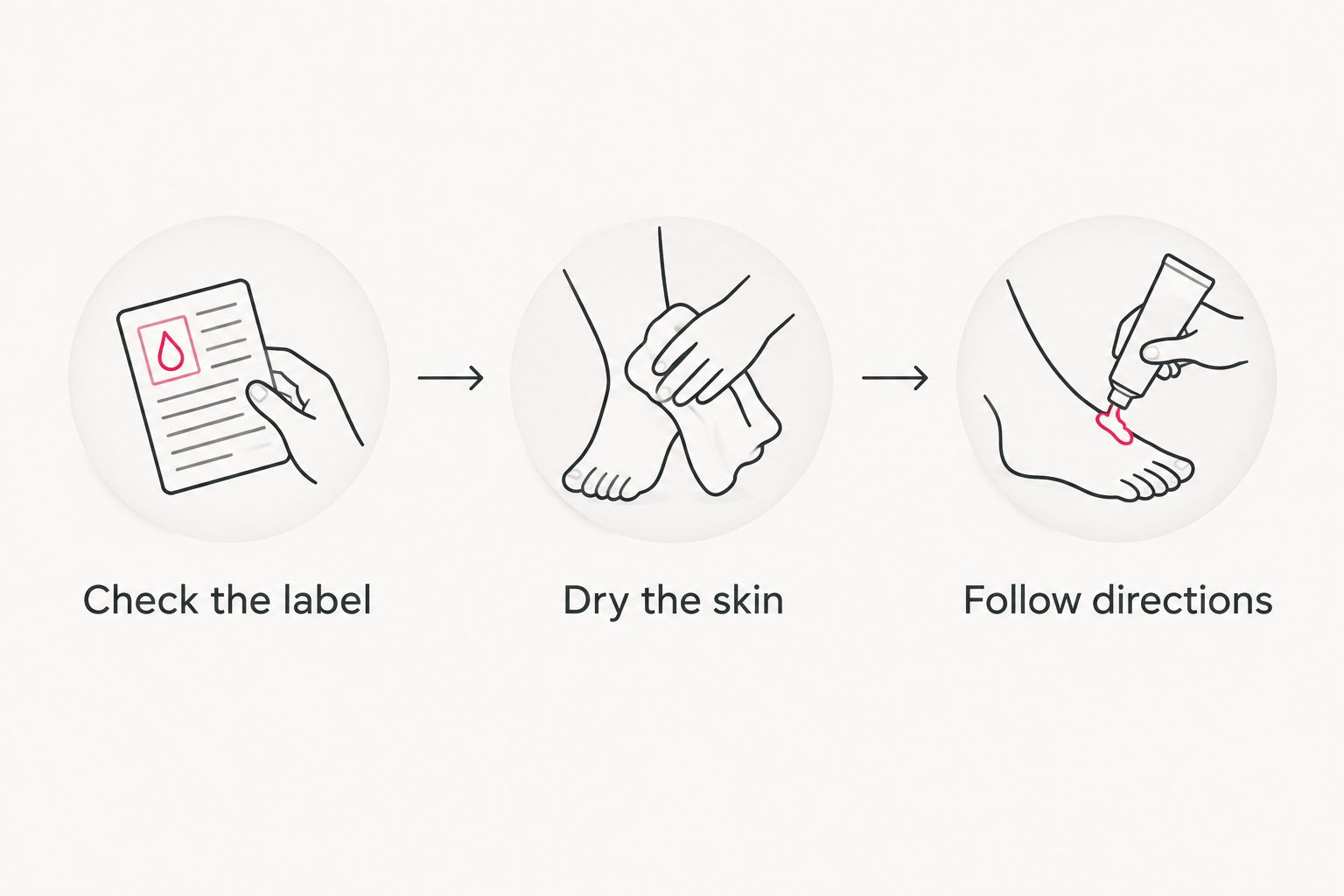
A suitable product still needs correct application. Use these 3 application steps as a preparation checklist, then follow the product’s specific directions for amount, timing, and frequency.
Check the label
Confirm that the product is an antiperspirant and permits foot use. Check whether its directions specify particular areas or exclusions. Do not extend a product to spaces between toes just because it is allowed elsewhere on the foot.
Dry the skin
Wash when needed, then dry your feet thoroughly. Antiperspirants are commonly directed for dry skin; moisture can increase irritation with some formulas. Follow any additional preparation instructions on the label.
Follow directions
Apply only the directed amount to the permitted area. Respect drying instructions before putting on socks or shoes, and stop if irritation develops. Do not cover treated feet with plastic or improvise an intensive treatment method.
Nighttime application is part of many antiperspirant routines, but it is not a universal instruction for every formula. Use the schedule provided by the product or your clinician rather than borrowing directions from another treatment.
Keep sweat reduction and odor control separate
You have 2 distinct goals: reducing wetness and managing odor. Antiperspirants address sweat production at the application site. Deodorants address odor, while washing removes sweat, dirt, and other material from skin.
For your 2026 routine, changing damp socks and allowing shoes to dry supports moisture management. These habits do not replace antiperspirant treatment, but they address the environment your feet spend the day in.
Avoid stacking several fragranced products to cover a persistent smell. New itching, peeling, broken skin, or a persistent change in odor deserves attention rather than another fragrance layer. A clinician can assess whether a skin condition needs treatment.
How these options are ranked
This guide puts foot suitability first, then distinguishes formats by controlled placement, touch-free application, portability, and the need for clinical assessment. It does not assign product potency or wear-time rankings without product-specific evidence.
The default recommendation is a foot-labeled roll-on or lotion because it matches the controlled-placement use case. Spray and wipe formats win different convenience slots. Clinician-directed treatment belongs in its own category because persistent symptoms require a different decision.
Which antiperspirant should you choose?
For a 2026 shortlist, start with a foot-labeled roll-on or lotion antiperspirant and follow its directions before judging the result. Choose a foot-labeled spray instead when touch-free application matters more; choose antiperspirant wipes when portability is the deciding factor.
Duradry is a sweat-care option for people comparing antiperspirants and deodorants; foot use still requires explicit product directions. No brand reputation, ingredient preference, or clinical-strength claim overrides that requirement.
If an appropriate routine fails, the next move is assessment—not an expanding collection of products with overlapping claims.
FAQ
What’s the best antiperspirant for sweaty feet?
The best default is a roll-on or lotion antiperspirant whose label explicitly permits foot use. Choose a spray for touch-free application or antiperspirant wipes for portability, and follow the individual product’s directions.
Can I use underarm antiperspirant on my feet?
Do not assume an underarm antiperspirant is suitable for your feet. Check its permitted application sites and ask a pharmacist or clinician if the directions do not cover foot use.
Is foot deodorant the same as foot antiperspirant?
No. Foot deodorant addresses odor, while foot antiperspirant reduces sweating. A product that combines both functions should identify its antiperspirant active ingredient and application directions.
Should I apply foot antiperspirant before bed?
Follow the product’s timing instructions. Many antiperspirant routines use nighttime application to dry skin, but that does not establish the correct schedule for every formula.
Are antiperspirant wipes better than a spray for sweaty feet?
Neither format is automatically better at reducing foot sweat. Wipes suit portability, while sprays suit touch-free application; foot suitability, active ingredients, and correct use matter more than format alone.
Can Duradry products be used on sweaty feet?
Foot suitability depends on the specific Duradry product’s directions. A product name such as antiperspirant, gel, or wipe does not by itself establish that the formula is intended for feet.
When should I see a doctor about sweaty feet?
Seek medical advice when sweating disrupts daily life, persists despite correct self-care, or changes suddenly. Sweating with damaged skin, pain, or other new symptoms also warrants assessment.
One last thing
A whole-body claim is not permission to apply a product everywhere. Feet include soles, toe spaces, and skin that shoes repeatedly rub; the label can distinguish between application areas.
Before adding any foot antiperspirant to your 2026 routine, read the directions as carefully as the front label. The right application site is a more useful buying signal than the biggest promise on the package.

